In 1966, following a controversial call that cost his team a victory, Florida State football coach Bill Peterson remarked upon a novel idea: “With all the electronic devices we have in football, why don’t we have videotape or something like it to help officials?”
You see, just three years earlier CBS had aired the first replay ever. CBS Director Tony Verna had almost single-handedly made it possible, outfitting a 1200-pound videotape machine for the job and pioneering a system that could efficiently track time on the recorded videotape. During an Army-Navy football game on December 7, 1963, replay made its debut following an Army touchdown. The concept was so shocking that broadcaster Lindsey Nelson needed to tell viewers that “Army did not score again!” Tex Schramm, who hired Verna and would go on to become General Manager of the Dallas Cowboys, immediately grasped the historic impact, saying to Verna: “What you have done here will have such far-reaching implications, we can’t begin to imagine them.”
Almost half a century later, those implications have certainly been realized. As Brad Willie, Vice President of Dixon Sports Consulting explains in regard to video replays: “We can control up to 16 cameras… We can show forward and backward slow-motion, frame-by-frame, and jogging. If they want to see another another angle or the first angle again… we can do all of those motions with one operator.” Every play of every professional sports game is filmed from multiple angles, and a close play never passes by on television without multiple replays.
And yet, in the 2009 Major League Baseball postseason, Joe Mauer was forced to continue batting after he had roped a ball into the left-field corner, seemingly for an obvious double, because the umpire called it foul.
And yet, in that same postseason, Robinson Cano was allowed to stay at third base after both he and Jorge Posada were seemingly tagged out by Mike Napoli while standing in the vicinity of the bag, because the umpire ruled him safe.
And yet, in June of 2010, Armando Galarraga got credit only for a one-hit shutout despite seemingly retiring 27 consecutive batters for the 20th perfect game in Major League history, because the umpire called the 27th batter of the game safe on a groundball to first baseman Miguel Cabrera.
You know what really happened, and every fan watching on television knew what had really happened within seconds: Mauer had, in fact, hit a double, Napoli had actually tagged out both Posada and Cano, and Galarraga did indeed complete a perfect game. But umpires Phil Cuzzi, Tim McClelland, and Jim Joyce, respectively, saw the plays differently—that is to say, wrong—and there was no recourse in place to correct their mistakes.
Forty-five years after Bill Peterson first lobbied for some technical aid for officials, in Major League Baseball those officials are still not permitted look at a replay to see what truly occurs except in very specific circumstances. While every fan across the world knew the proper calls immediately afterward, the umpires—the only people who could change the official result—were the only people not allowed to consult video replay to get a second look at the plays.
At this point, Major League Baseball is pretty much alone in that resepct. Across the board, professional sports leagues have expanded instant replay to aid their officials.
The National Football League first experimented with replay in 1986. After a trial period, it disappeared because of the league’s top-heavy voting policy, though 17 of 28 teams and the commissioner at the time, Paul Tagliabue, were all in favor of continuing with it. Said Jim Finks, then the owner of the New Orleans Saints, twenty years ago, “We’ll regret the day we voted it down. This is a major step backward for the NFL. This is stupidity on the part of our league.” His words proved true when, eight years later, the NFL re-introduced instant replay, and has continued to use it extensively since then.
The National Basketball Association has been using instant replay since 2002, at first only to judge whether shots at the end of quarters were released in time. Stu Jackson, the NBA’s Senior Vice President for Basketball Operations, explained: “Plays sometimes occur in which it is impossible for a human being to determine whether the play took place before time expired.” It’s not exactly a revelation that human beings are fallible, but admitting it and working to make up for it is something every other sport has been willing to do. The NBA is constantly looking to improve replay, with an instant replay committee featuring general managers and coaches approving additional replay opportunities both in 2008 and 2009.
The National Hockey League’s use of instant replay dates back to 1991, when officials were newly allowed to check close calls on goals and potential goals, and it streamlined the process in 2003 by giving the responsibility to off-ice officials. With the initial inception of replay in 1991, NHL president John Ziegler pointed out: “We can at least…provide assistance to those people, who, under great pressure and at very difficult times, have to make these difficult decisions.”
NASCAR uses instant replay to determine if cars pass into pit road before a caution flag is raised. Professional tennis, encompassing both the USTA and WTA, has taken on more extreme measures, using a computerized system termed HawkEye, rather than video replay, to judge if a ball lands in or out. In defending the decision in 2006, USTA CEO Arlen Kantarian said: “We have to change with the times… We can’t stick our heads in the sand.” In college football, multiple conferences have recently upgraded to High Definition replay in college football.
What has prevented instant replay from taking hold in baseball, when every other American professional and college sport with the means to use it does so extensively? Why is it that the authorities in each of the aforementioned leagues have realized the benefits of instant replay, but MLB commissioner Bud Selig staunchly opposed its introduction and stubbornly continues to fight against any additions? It boils down to his faulty reasoning, and the shrinking number of people who indulge each aspect of it. Wall Street Journal contributor Jason Gay separates these people into three different groups: the romantics, the slippery slopers, and the laughably impatient.
New York Times writer George Vecsey exemplifies the romantics’ point of view: “Imperfect umpires are as much a part of this sport as imperfect fielders who muff a pop fly or imperfect runners who neglect to touch a base.” They are traditionalists who think that umpiring errors are part of the game because, well, they always have been, and for that reason they must stay. They fear that instant replay will remove the human element, and, as Selig described, “It’s been said for 150 years that you can’t remove the human element from baseball.”
That reasoning is both mistaken and misguided. Humans will stay play the game, and humans will still umpire the game, but those umpires will just be able to use technology to help them make difficult calls. Instant replay will only eliminate the human element insofar as the human element is synonymous with officiating mistakes.
Even more ridiculous is the notion that it is tradition for umpires to make incorrect calls, accidentally of course, and thus that they must be able to do so. Do these people think that if, when baseball was first played in the mid-nineteenth century, players and coaches had had the option of using a replay system they would have balked at it? As Vecsey points out, umpires in that era often asked passing spectators for help with calls. At one point, that was tradition too, but baseball got rid of it because it correctly decided that it was not the best way to officiate games. The only reason that, for 150 years, people have said you can’t remove the human element—again, the human element being equivalent to incorrect calls—from baseball is that for the first 140 years you couldn’t. And we still can’t entirely eliminate it, but thanks to advanced video technology we can significantly limit its affect on the game.
Even in a sport that usually changes at a lurching pace, there are other examples of parting with tradition. For instance, in January of 2009, a new rule was approved to get rid of “the traditional and historic practice of using coin flips to determine which team hosts a one-game playoff.” This was a direct result of a one-game playoff the previous season in which Minnesota played Chicago for the American League Central title and a spot in the postseason. The White Sox had won the coin-flip, forcing Minnesota to travel to Chicago for the game that they subsequently lost 1-0. The Minnesota organization complained bitterly that, despite having won the season series, they had to play on the road for the play-in game. Lo and behold, that was adopted as the new rule within months. And the very next season, Minnesota again was in a one-game playoff for the division crown, but this time Detroit had to meet them in Minneapolis because of the rule change.
In 2010, the Twins again stirred controversy, as they managed a ninth-inning victory over Tampa Bay when an infield popup off the bat of Jason Kubel struck a catwalk close to the roof of Tropicana Field and dropped in for a game-winning single as a result. This time, Major League Baseball didn’t even wait until the offseason to change the rule, stipulating that, starting with the 2010 postseason, any ball that hit a catwalk would result in a do-over. Joe Garagiola Jr., Senior Vice President of Baseball Operations, explained that the rule would “take an element of randomness out of the game.”
Both those rule changes were made in the attempt to create a fairer game with less randomness outside of the skill of the players involved, and ignored any sense of tradition that had kept them in place previously. You know what else would achieve both of those goals? Instant replay. It would help eliminate randomness regarding whether a play was called correctly or not, and I think everyone will agree that would make the game fairer.
But, of course, those aforementioned rule changes were much simpler than instituting full-fledged instant replay. That’s where the slippery slopers and the laughably impatient come in. Not necessarily in favor of the errant calls made by umpires, as the romantics are, these two groups are concerned with the precedent more instant replay will set and with the delays it will cause.
Mike Scioscia, the current manager of the Los Angeles Angels, articulated the slippery slope argument perfectly: “It should be limited to a home run or fan interference [as it currently is]. There are so many things that you can question that it would be almost dysfunctional.” Oftentimes, opponents of instant replay will carry that line of thinking to outrageous ends, wondering how soon it will be until robots replace umpires entirely and machines play the game instead of humans.
That argument is pure fallacy. Obviously, carrying any policy to its furthest extent will make it look absurd, and intimating that instant replay will be like a runaway train once it starts is doing just that. As long as the rules regarding instant replay are carefully constructed, as just about everything in the Major League rulebook is, it will not degenerate into a system that looks at every play and turns umpires into powerless spectators.
Oh, but what about all the time it will waste, the laughably impatient argue. This is a legitimate concern, as Major League Baseball is already attempting to implement strategies that will shorten games and prevent them from regularly pushing beyond three hours. This group’s mistake, therefore, is not in worrying about time, but in thinking that instant replay will significantly lengthen games. Instant replay will not be the drag on game pace that these folk think it would.
For a case study, consider the Little League World Series (LLWS), a set of baseball games played by 12-year olds for free, which has instituted extensive instant replay, allowing umpires a second look at force outs, tags, missed bases, and hit batters. In the 30 games played during the 2010 LLWS prior to the final day of the tournament, sixteen calls were reviewed—eight of which were overturned—and the average delay was estimated at 52 seconds. For the small price of approximately 30 extra seconds per game, the LLWS made significant strides toward eliminating all erroneous calls.
On top of that, there’s the fact that baseball often already experiences lengthy delays on controversial or missed calls, and thus there is the possibility that instant replay won’t truly add any time to games. We’ve all seen a manager walk out of the dugout, despite knowing that nothing will be changed, to get in a shouting match with an umpire that winds up wasting multiple minutes while everyone else simply watches the spit fly from both of their mouths. With instant replay, the umpire will instead spend that time making sure the correct ruling is made. That sounds pretty good to me.
Then there’s the last type of person who advocates against instant replay, the Michael Hiestands of the world. Like the USA Today writer, they are so misguided you realize there’s no hope of convincing them, and you just hope there aren’t enough of them out there to stand in the way. In the process of denouncing replay, Hiestand writes the following: “Thanks to technology, we’re no longer allowed to get lost, ever be out of touch with the office or late with a check that’s, uh, in the mail. Spellcheck, GPS, TiVo, red light cameras, and thermometers stuck in turkeys keep taking guesswork out of our lives.”
I understand the sentiment, but to suggest that the negative aspects of those technological advancements outweigh the positives is preposterous. Yes, it’s harder to pretend we’ve gotten lost, but what about the times when we previously would have ended up driving in circles for hours and can now avoid it? Yes, it’s harder to be out of touch with the office, but what about the ability to be in contact with friends and loved ones around the world that technology has afforded us? Yes, it’s harder to dupe our credit card company, but what about possibility of paying that bill online on the last day since you forgot and otherwise would owe huge late fees? And, yes, instant replay will mean sometimes we won’t get the benefit of a bad call, but Armando Galarraga won’t lose his place in baseball lore because of an umpiring mistake either. Enjoy your guesswork, Mr. Hiestand—I’ll take the technology.
Considering the amount of time I just spent debunking the myths that opponents of instant replay use as arguments, it would seem that they are in the majority; that, however, is not the case. Even back in 1986, when the technology was much more limited, 66 percent of fans thought the NFL’s replay system improved the game, compared to just 20 percent who thought it made the game worse. As for baseball fans, after Galarraga was robbed of his perfect game in June of 2010, 78 percent came out in favor of instant replay. Look at any survey you want, and they all send the same message.
So where does Selig draw his support from? “Most baseball people are really against it. There’s no question about it,” he explains. I don’t doubt that some baseball people agree with the romantics, the slippery slopers, and the laughably impatient, but there are certainly plenty that have publicly embraced replay. Managers such as the Rays’ Joe Maddon, the Pirates’ Clint Hurdle, and Tony LaRussa (Cardinals) have all given their stamp of approval. As La Russa put it, “There’s nothing wrong with using replay. The number one priority for the umpire is to get the play right.”
Many umpires, long stubborn antagonists against replay, have also recently converted. Don Denkinger, who made one of the most infamous blown calls in the history of the sport in the 1985 World Series, is among them: “I had 30 great years…and I had one call that’s all anybody ever wants to talk about. It’s not right.” He continued, “Instant replay can clean things up… I didn’t feel that way in ’85, but I feel that way now.” Tim McClelland, who missed one of the calls described in the introduction, has also had a change of heart: “I know I wasn’t for it. But after watching what I went through in the playoffs last year and then what Jim [Joyce]’s going through, I think more and more umpires are coming around to it.”
Anybody who saw Joyce’s tearful press conference after he ruined Armando Galarraga’s perfect game can’t help but feel sorry for the guy. They know what he wanted most was to get that call right and to give Galarraga his place in history. His fellow umpires have largely swallowed their pride, too, and admitted that, like every human on the planet, they are imperfect and could use the help. They take such a beating for missing calls, if they are ready to embrace replay technology, who are we to deny them?
Despite Selig’s assurances, both the fans and enough baseball people are ready for expanded instant replay that it’s time for him to forget his personal feelings and start working on the logistics of it. Lucky for him, it’s not that complicated, and there are improvements he can make to the existing system that will mitigate his concerns.
There is no doubt that the technology is there to make instant replay work on an extended basis. ESPN uses 14 cameras when it broadcasts Sunday Night Baseball and 7 cameras for other baseball broadcasts, and Fox Sports, which broadcasts many local games, has 8 cameras at its disposal at most of its games. As ESPN Vice President of Event Production Tim Scanlan reports, even with 7 cameras, ESPN is “able to provide a second or third look that the umpire doesn’t have.” College football sometimes even uses replay in non-televised games by using 4 cameras for the sole purpose of replay reviews.
That’s one argument you will often hear regarding the logistics: if every single one of the 2,430 regular season games scheduled each year can’t have replay, then none should. What’s the reasoning for that? Essentially, because a handful of games aren’t televised each year, each game should be less fair? Because in a few games each season teams are still subject to blatant officiating errors, teams should be subject to them in every game? Having replay does not make the games without replay less fair, but preventing replay from being expanded in those games that can have it misses an opportunity to make those games more fair.
That being said, the current method of replay must be changed to allay Selig’s and fans’ legitimate worries about extending games. Having the umpires leave the field is an unnecessary and costly measure in terms of the resultant delay. Instead, as is done in the NHL and NCAA football among other sports, baseball can have the calls reviewed by off-field personnel. They can put an umpire in the press box, or anywhere in the stadium with access to replay, and allow him to communicate with the crew chief on the field via a microphone. If he sees a close play, he takes a look and tells the umpire he is doing so. By the time Josh Beckett has taken his average 45 seconds between pitches, he’s already made up his mind about what is to be done. If the play is close enough that he can’t make up his mind within a reasonable amount of time, he sticks with what was called on the field.
Obviously this would necessitate adding an extra umpire for each game, but I think that small cost is definitely worth it. Besides, we’ve seen it happen before. You probably aren’t aware, but in 1977 the Atlanta Braves put an umpire in the press box to determine if replays were too controversial to show on the stadium video board. That practice didn’t catch on, but, instead of using him in an attempt to prevent fans from knowing the truth, couldn’t they use him to help the umpires know the truth and change the call? Now that would keep the fans’ anger with the umpires at bay.
Here’s one example of how it would work which I happened to witness in an Angels-Twins game while writing this. Erick Aybar was leading off the bottom of the first inning against Minnesota’s Carl Pavano in a game on September 2. He grounded a ball to first baseman Luke Hughes, who made a diving stop, and then was forced to race Aybar to the bag since Pavano was slow off the mound. On a bang-bang play, Aybar was called out by the first base umpire. As the TV broadcast showed a replay definitively confirming the original call within 10 seconds, Mike Scioscia left the dugout and spent between 30 and 40 seconds discussing the call with the umpire.
It seems so simple. In that case, replay would have actually saved time. In fact, if it worked ideally, you wouldn’t even know the play was reviewed, as the normal time in between batters would have been more than the time used to review the play. And, if it had been overturned, it wouldn’t have taken much more than the 30 or 40 seconds to do so, even including the time to get Aybar out of the dugout and on first base.
When baseball finally does expand instant replay, which it will eventually, it will not be the most unprecedented use of replay in baseball history. And the initial inception of replay for home run calls wasn’t either. No, that was in a 1999 game when umpire Frank Pulli went to a camera in the Florida Marlins’ dugout to review a home run call. Long before there was any rule stipulating for replay, Pulli decided it was in the game’s best interest that he get the call right, tradition be damned. Upon reviewing it, he saw conclusive evidence that Florida’s Cliff Floyd’s hit did not clear the wall, and changed the ruling from a home run to a double.
Why did Frank Pulli feel the need to consult a video replay? “At that moment, I thought it was the proper thing to do.” You can say that again.
Showing posts with label mlb. Show all posts
Showing posts with label mlb. Show all posts
Thursday, February 2, 2012

Friday, October 21, 2011
2011 All-MLB Teams
ALL-MLB FIRST TEAM
Catcher: Alex Avila, Detroit
First Baseman: Miguel Cabrera, Detroit
Second Baseman: Dustin Pedroia, Boston
Third Baseman: Adrian Beltre, Texas
Shortstop: Troy Tulowitzki, Colorado
Left Field: Ryan Braun, Milwaukee
Center Field: Matt Kemp, Los Angeles NL
Right Field: Jose Bautista, Toronto
Designated Hitter: David Ortiz, Boston
Starting Pitchers: Justin Verlander, Detroit; Roy Halladay, Philadelphia; Cliff Lee, Philadelphia; Clayton Kershaw, Los Angeles NL; Jered Weaver, Los Angeles AL
Relief Pitchers: Craig Kimbrel, Atlanta; Mike Adams, San Diego/Texas; Mariano Rivera, New York AL
ALL-MLB SECOND TEAM
Catcher: Mike Napoli, Texas
First Baseman: Adrian Gonzalez, Boston
Second Baseman: Ian Kinsler, Texas
Third Baseman: Evan Longoria, Tampa Bay
Shortstop: Jose Reyes, New York NL
Left Field: Alex Gordon, Kansas City
Center Field: Jacoby Ellsbury, Boston
Right Field: Justin Upton, Arizona
Starting Pitchers: Cole Hamels, Philadelphia; Dan Haren, Los Angeles AL; James Shields, Tampa Bay; Doug Fister, Seattle/Detroit; C.C. Sabathia, New York AL
Relief Pitchers: Jonathan Papelbon, Boston; Koji Uehara, Baltimore/Texas; David Robertson, New York AL
ALL-MLB THIRD TEAM
Catcher: Miguel Montero, Arizona
First Baseman: Joey Votto, Cincinnati
Second Baseman: Brandon Phillips, Cincinnati
Third Baseman: Aramis Ramirez, Chicago NL
Shortstop: J.J. Hardy, Baltimore
Left Field: Matt Holliday, St. Louis
Center Field: Curtis Granderson, New York AL
Right Field: Lance Berkman, St. Louis
Starting Pitchers: Ian Kennedy, Arizona; C.J. Wilson, Texas; Josh Beckett, Boston; David Price, Tampa Bay; Felix Hernandez, Seattle
Relief Pitchers: Tyler Clippard, Washington; Sean Marshall, Chicago NL; Rafael Betancourt, Colorado
A reminder that each player was only eligible at one position, that position being the one he played most often.
Thursday, October 20, 2011
Stan Musial Award for Best Player
The last of the Baseball Blogger's Alliance awards is also the biggest: the Stan Musial Award, its version of the MVP. I'll reveal my thoughts on both leagues, though, as with all the other awards, my ballot is only eligible for the American League voting.
AMERICAN LEAGUE
1. Jacoby Ellsbury, BOS
2. Jose Bautista, TOR
3. Justin Verlander, DET
4. Miguel Cabrera, DET
5. Curtis Granderson, NYY
6. Adrian Gonzalez, BOS
7. Jered Weaver, LAA
8. Alex Gordon, KC
9. Alex Avila, DET
10. Dustin Pedroia, BOS
Also considered: Ian Kinsler (TEX), Robinson Cano (NYY), Adrian Beltre (TEX), Evan Longoria (TB), Dan Haren (LAA), James Shields (TB)
NATIONAL LEAGUE
1. Matt Kemp, LAD
2. Ryan Braun, MIL
3. Troy Tulowitzki, COL
4. Roy Halladay, PHI
5. Joey Votto, CIN
6. Prince Fielder, MIL
7. Cliff Lee, PHI
8. Clayton Kershaw, LAD
9. Justin Upton, ARI
10. Albert Pujols, STL
Also considered: Lance Berkman (STL), Andrew McCutchen (PIT), Jose Reyes (NYM), Cole Hamels (PHI)
AMERICAN LEAGUE
1. Jacoby Ellsbury, BOS
2. Jose Bautista, TOR
3. Justin Verlander, DET
4. Miguel Cabrera, DET
5. Curtis Granderson, NYY
6. Adrian Gonzalez, BOS
7. Jered Weaver, LAA
8. Alex Gordon, KC
9. Alex Avila, DET
10. Dustin Pedroia, BOS
Also considered: Ian Kinsler (TEX), Robinson Cano (NYY), Adrian Beltre (TEX), Evan Longoria (TB), Dan Haren (LAA), James Shields (TB)
NATIONAL LEAGUE
1. Matt Kemp, LAD
2. Ryan Braun, MIL
3. Troy Tulowitzki, COL
4. Roy Halladay, PHI
5. Joey Votto, CIN
6. Prince Fielder, MIL
7. Cliff Lee, PHI
8. Clayton Kershaw, LAD
9. Justin Upton, ARI
10. Albert Pujols, STL
Also considered: Lance Berkman (STL), Andrew McCutchen (PIT), Jose Reyes (NYM), Cole Hamels (PHI)
Wednesday, October 19, 2011
The Final Word on Instant Replay
Recently I wrote a lengthy article for an online magazine regarding the future of instant replay in baseball. I have long been a proponent of replay, and I attempt to once and for all explain why it's an important and necessary part of baseball--although I am quite certain I did not succeed, as some people will never agree with that statement.
Here's one paragraph from my article:
Here's one paragraph from my article:
Even more ridiculous is the notion that it is tradition for umpires to make incorrect calls, accidentally of course, and thus that they must be able to do so. Do these people think that if, when baseball was first played in the mid-nineteenth century, players and coaches had had the option of using a replay system they would have balked at it? As Vecsey points out, umpires in that era often asked passing spectators for help with calls. At one point, that was tradition too, but baseball got rid of it because it correctly decided that it was not the best way to officiate games. The only reason that, for 150 years, people have said you can’t remove the human element—again, the human element being equivalent to incorrect calls—from baseball is that for the first 140 years you couldn’t. And we still can’t entirely eliminate it, but thanks to advanced video technology we can significantly limit its affect on the game.Read more...
Tuesday, October 18, 2011
Walter Johnson Award for Best Pitcher
I'll continue revealing my ballot for the Baseball Bloggers Alliance's postseason awards. Today I'll look at the Walter Johnson Award, given to the top pitcher in each league. Again, my votes count only for the American League, but I'll show you my thoughts on both.
AMERICAN LEAGUE
1. Justin Verlander, DET
2. Jered Weaver, LAA
3. Dan Haren, LAA
4. James Shields, TB
5. Doug Fister, SEA/DET
I think Verlander will run away with this, and rightfully so. Among AL pitchers, he ranked first in IP, ERA, and WHIP, second in xFIP, third in K/9 and K/BB, and fourth in FIP. Not to knock the other pitchers on this list, as they all had great seasons in their own right, but I can't see an argument for someone other than Verlander.
Teammates Weaver and Haren put together quite the 1-2 punch for the Angels this season. Neither struck out a ton of batters, just a respectable amount, but both threw over 235 innings and placed second and third, respectively, in the AL in WHIP. Weaver also was second by 0.01 points in ERA, and Haren led the league in K/BB ratio, thanks to the second-lowest walk rate in the bigs. Some batted ball luck certainly helped Weaver, who had the lowest GB% among qualified starters, but he was pretty good too.
Shields almost reached 250 innings and rated well across the board. Fister is surely the most surprising and controversial name on my list, as I was shocked to find him there myself. His strikeout rate was mediocre, but because of impeccable control he was fifth in the AL in strikeout-per-walk ratio. Combining that with an above-average groundball rate, he was also in the top six in ERA, WHIP, and FIP. I doubt anyone else will have him ahead of C.C. Sabathia, but I thought that statistically Fister had the better year.
Also considered: C.C. Sabathia (NYY), C.J. Wilson (TEX), Josh Beckett (BOS), David Price (TB), Felix Hernandez (SEA)
NATIONAL LEAGUE
1. Roy Halladay, PHI
2. Cliff Lee, PHI
3. Clayton Kershaw, LAD
4. Cole Hamels, PHI
5. Ian Kennedy, ARI
Halladay won this award last year, and he should again in 2011, followed closely by two teammates and Kershaw. Looking at this, it's hard to believe the Phillies aren't still playing, but that's baseball for you. The first three were all very close, but Halladay prevailed because of a league-best K:BB ratio and FIP combined with an excellent ERA and WHIP. Hamels was a pretty easy choice for fourth, and then the last spot was a toss-up between Kennedy and Cain. Kennedy grabbed it because in the end I valued his superior K:BB ratio more than Cain's continuous home run-dampening ability. I know a lot of people would have Cain's teammate Lincecum in the top five somewhere, but I just couldn't put him there because of his comparatively high walk rate and subsequently comparatively high WHIP.
Also considered: Matt Cain (SF)
AMERICAN LEAGUE
1. Justin Verlander, DET
2. Jered Weaver, LAA
3. Dan Haren, LAA
4. James Shields, TB
5. Doug Fister, SEA/DET
I think Verlander will run away with this, and rightfully so. Among AL pitchers, he ranked first in IP, ERA, and WHIP, second in xFIP, third in K/9 and K/BB, and fourth in FIP. Not to knock the other pitchers on this list, as they all had great seasons in their own right, but I can't see an argument for someone other than Verlander.
Teammates Weaver and Haren put together quite the 1-2 punch for the Angels this season. Neither struck out a ton of batters, just a respectable amount, but both threw over 235 innings and placed second and third, respectively, in the AL in WHIP. Weaver also was second by 0.01 points in ERA, and Haren led the league in K/BB ratio, thanks to the second-lowest walk rate in the bigs. Some batted ball luck certainly helped Weaver, who had the lowest GB% among qualified starters, but he was pretty good too.
Shields almost reached 250 innings and rated well across the board. Fister is surely the most surprising and controversial name on my list, as I was shocked to find him there myself. His strikeout rate was mediocre, but because of impeccable control he was fifth in the AL in strikeout-per-walk ratio. Combining that with an above-average groundball rate, he was also in the top six in ERA, WHIP, and FIP. I doubt anyone else will have him ahead of C.C. Sabathia, but I thought that statistically Fister had the better year.
Also considered: C.C. Sabathia (NYY), C.J. Wilson (TEX), Josh Beckett (BOS), David Price (TB), Felix Hernandez (SEA)
NATIONAL LEAGUE
1. Roy Halladay, PHI
2. Cliff Lee, PHI
3. Clayton Kershaw, LAD
4. Cole Hamels, PHI
5. Ian Kennedy, ARI
Halladay won this award last year, and he should again in 2011, followed closely by two teammates and Kershaw. Looking at this, it's hard to believe the Phillies aren't still playing, but that's baseball for you. The first three were all very close, but Halladay prevailed because of a league-best K:BB ratio and FIP combined with an excellent ERA and WHIP. Hamels was a pretty easy choice for fourth, and then the last spot was a toss-up between Kennedy and Cain. Kennedy grabbed it because in the end I valued his superior K:BB ratio more than Cain's continuous home run-dampening ability. I know a lot of people would have Cain's teammate Lincecum in the top five somewhere, but I just couldn't put him there because of his comparatively high walk rate and subsequently comparatively high WHIP.
Also considered: Matt Cain (SF)
Monday, October 17, 2011
BBA Announces Goose Gossage Award Winner
The following is a press release from the Baseball Bloggers Alliance, of which Twins on Twins is a voting member, announcing the winners of the Goose Gossage Award for the top reliever in each league. Clearly most of the voters valued saves far more highly than I did, although I did agree with the NL choice of Craig Kimbrel.
-------------------------------------------------
BBA SELECTS KIMBREL, VALVERDE FOR GOOSE GOSSAGE AWARD
In earlier voting this postseason by the Baseball Bloggers Alliance, Atlanta Braves closer Craig Kimbrel won the Willie Mays Award for top rookie handily while the American League race for that award was much tighter. With the Goose Gossage Award, handed out to the best reliever, Kimbrel got to see how the other half lives, at least somewhat.
Kimbrel beat Milwaukee’s John Axford by 13 points in the votes submitted by the National League voters of the Alliance, accumulating 78 points and garnering 12 first place votes. Axford, on the other hand, received 65 points on the strength of seven first place selections. Kimbrel’s bullpen teammate Johnny Venters was a very distant third with nine total points.
The race in the American League was a little more anti-climatic as Detroit closer Jose Valverde gained 13 first place votes on his way to a league-leading 74 point total. Two New York Yankees followed him in the voting, with Mariano Rivera receiving four first place votes and 56 total points while David Robertson gained 39 points for third.
The complete voting results are as follows (first place votes in parenthesis):
American League
Jose Valverde, Detroit (13) 74
Mariano Rivera, New York (4) 56
David Robertson, New York (3) 39
Jonathan Papelbon, Boston (1) 21
Koji Uehara, Texas (1) 6
Alfredo Acevas, Boston (1) 5
Neftali Feliz, Texas 2
Greg Holland, Kansas City 2
Chris Perez, Cleveland 2
Brandon League, Seattle 1
Vinnie Pestano, Cleveland 1
National League
Craig Kimbrel, Atlanta (12) 78
John Axford, Milwaukee (7) 65
Johnny Venters, Atlanta (1) 9
Joel Hanrahan, Pittsburgh 8
JJ Putz, Arizona 7
Sean Marshall, Chicago 6
Heath Bell, San Diego 3
Tyler Clippard, Washington 3
Sergio Romo, San Francisco 1
The Baseball Bloggers Alliance was formed in the fall of 2009 to encourage cooperation and collaboration between baseball bloggers of all major league teams as well as those that follow baseball more generally. As of this writing, the organization consists of 316 blogs spanning all 30 major league squads as well as general baseball writing.
The BBA is organized under a similar structure as the Baseball Writers of America, where blogs that follow the same team are combined into “chapters” and only two votes from the chapter on an award are counted. The blog chapters that are focused on general baseball were allowed two votes as well, which they could use both on the same league or split between the two leagues.
Chapters generally followed one of two methods when casting their ballot. Either representatives of the chapter were given the ballots for voting or a “group ballot” was posted, accounting for both of their votes.
Notably, though the Alliance’s awards come out well before their official counterparts, the BBA selections have matched those of the Baseball Writers of America in all but two instances in the past two years. This, of course, does not include the Goose Gossage Award that is exclusive to the BBA.
Ballots are posted on the respective blogs and for this award, were tabulated on a 5-3-1 point scale for first through third place. In the interest of transparency, links are given below for the ballots. Chapter affiliation is in parenthesis. Those chapters that decided on the group method are noted with an asterisk.
American League
Baltimore Sports and Life (Baltimore)
Baseball Is My Boyfriend (Texas)*
Baseball North (Toronto)
Boston Red Thoughts (Boston)*
Contract Year (Oakland)*
The Flagrant Fan (General)
Kings of Kauffman (Kansas City)*
Lady At The Bat (New York)
Misc. Baseball (History)
Motor City Bengals (Detroit)
North Dakota Twins Fan (Minnesota)
The Rays Rant (Tampa Bay)
Seattle Mariners Musings (Seattle)
Seedlings To Stars (Other)
Some Thoughts On Baseball (Toronto)
Tigers Amateur Analysis (Detroit)
The Tribe Daily (Cleveland)*
Twins On Twins (Minnesota)
National League
Appy Astros (Houston)
Blog Red Machine (Cincinnati)
Cincinnati Reds Blog (Cincinnati)
Dugger Sports (Philadelphia)
The Eddie Kranepool Society (New York)*
The Flagrant Fan (General)
Misc. Baseball (History)
On The Outside Corner (St. Louis)
Phils Baseball (Philadelphia)
Prose and Ivy (Chicago)*
Raise The Jolly Roger (Pittsburgh)
RJ’s Fro (San Diego)
Rockies Woman (Colorado)
22 Gigantes (San Francisco)
Victoria Seals Baseball Blog (Other)
Websoulsurfer (San Diego)
Where Have You Gone, Andy Van Slyke? (Pittsburgh)
Prior Winners: 2010: Rafael Soriano, Tampa Bay; Brian Wilson, San Francisco
The official website of the BBA is located at baseballbloggersalliance.
Saturday, October 15, 2011
Willie Mays Award for Best Rookie
So the Baseball Bloggers Alliance has actually already handed out this award, so I'm a little late to the party. Still, I wanted to share my would-have-been ballot for who deserved each award.
AMERICAN LEAGUE
1. Eric Hosmer, KC
2. Michael Pineda, SEA
3. Jeremy Hellickson, TB
Hosmer and Trumbo were clearly the best of the position players, at least in my opinion. Hosmer's superior batting average and plate discipline numbers gave him the edge, in addition to Trumbo's huge advantage on defense likely not being an accurate measure of each player's performance in the field. The three pitches--Pineda, Hellickson, and Ogando--are very closely grouped. Pineda and Ogando have better peripherals, while Hellickson had better results (i.e. ERA and WHIP). Pineda's strikeout rate was enough to overcome that, while Ogando's was not.
Also considered:Alexi Ogando (TEX)*, Mark Trumbo (LAA), Ivan Nova (NYY)
NATIONAL LEAGUE
1. Craig Kimbrel, ATL
2. Danny Espinosa, WAS
3. Freddie Freeman, ATL
I have a hard time voting for a reliever over an everyday player, but Kimbrel's dominance was unmatched, as noted by his appearance at the top of my ballot for the best NL reliever. When you're the top player at your position, that's grounds for the rookie of the year award. Most people have Freeman over Espinosa for the second position, but I don't agree. They have similar counting numbers, but Freeman has the better triple-slash while Espinosa played much better defense at a more difficult position. I gave Espinosa the edge.
Also considered: Brandon Beachy (ATL), Wilson Ramos (WAS), Cory Luebke (SD), Vance Worley (PHI)
*Ogando is not eligible for the Rookie of the Year award. I mistakenly included him as a consideration.
AMERICAN LEAGUE
1. Eric Hosmer, KC
2. Michael Pineda, SEA
3. Jeremy Hellickson, TB
Hosmer and Trumbo were clearly the best of the position players, at least in my opinion. Hosmer's superior batting average and plate discipline numbers gave him the edge, in addition to Trumbo's huge advantage on defense likely not being an accurate measure of each player's performance in the field. The three pitches--Pineda, Hellickson, and Ogando--are very closely grouped. Pineda and Ogando have better peripherals, while Hellickson had better results (i.e. ERA and WHIP). Pineda's strikeout rate was enough to overcome that, while Ogando's was not.
Also considered:
NATIONAL LEAGUE
1. Craig Kimbrel, ATL
2. Danny Espinosa, WAS
3. Freddie Freeman, ATL
I have a hard time voting for a reliever over an everyday player, but Kimbrel's dominance was unmatched, as noted by his appearance at the top of my ballot for the best NL reliever. When you're the top player at your position, that's grounds for the rookie of the year award. Most people have Freeman over Espinosa for the second position, but I don't agree. They have similar counting numbers, but Freeman has the better triple-slash while Espinosa played much better defense at a more difficult position. I gave Espinosa the edge.
Also considered: Brandon Beachy (ATL), Wilson Ramos (WAS), Cory Luebke (SD), Vance Worley (PHI)
*Ogando is not eligible for the Rookie of the Year award. I mistakenly included him as a consideration.
Friday, October 14, 2011
Goose Gossage Award for Best Reliever
The Baseball Bloggers Alliance has started handing out their awards for the 2011 season. Up next is the Goose Gossage Award for the top reliever in each league. As a member of the BBA, I thought I'd share my ballot for the award. My vote will only count for the American League, as I'm a member of the Minnesota Twins chapter, but I've outlined my thoughts on both.
AMERICAN LEAGUE
1. Mariano Rivera, NYY
2. Jonathan Papelbon, BOS
3. Koji Uehara, BAL/TEX
Believe me, I did not give this to Rivera on reputation. He earned it once again (I realize he actually did not win it last year, he finished third) with a sparkling season. With nearly one strikeout per inning and impeccable control, Rivera totaled 7.5 strikeouts for every walk. He recorded a a 1.91 ERA (4th), a 0.90 WHIP (2nd), and a 2.19 FIP (3rd) to round out another phenomenal campaign at age 41.
Papelbon was a close 2nd, as he exhibited similar control but showed a much greater ability to miss bats, striking out 12.17 batter per nine innings. His WHIP was also quite comparable, coming in at 0.93, but due to some worse luck he had an ERA of 2.94. Unfortunately for him, luck is part of the equation, so he gets the runner-up position.
I don't think anyone will quibble with Rivera and Papelbon being on the ballot, but I'm a little worried people won't be as accepting of Uehara. He doesn't have the saves that Rivera and Papelbon do, but otherwise he's not far behind. Another guy who showed pinpoint control and still missed a bunch of bats, Uehara actually had the highest K/BB rate in the league (a ridiculous 9.44). He gave up a ton of homers, even more than you'd expect from a fly-ball pitcher such as himself, but he balanced that out with good luck in the BABIP department (.196). All in all, his zesty K/BB rate and league-best WHIP of 0.72 were too much to overlook.
Also considered: David Robertson (NYY), Daniel Bard (BOS)
NATIONAL LEAGUE
1. Craig Kimbrel, ATL
2. Tyler Clippard, WAS
3. Sean Marshall, CHC
Kimbrel has already claimed the BBA's Willie Mays Award for the league's top rookie, and now he should add the Goose Gossage Award to his mantle. His sky-high strikeout rate (14.84/9) was second to Kenley Jansen, and, while his control was never his strong suit, he averaged almost 4 strikeouts for every walk. Combining that with a solid ground ball rate (44.8 %) allowed Kimbrel to lead the NL in both FIP and xFIP. As long as his ERA (2.10) and WHIP (1.04) were reasonable--and they were better than reasonable--that was a recipe for winning this award.
Clippard may not find his way on to many ballots because he isn't as big a name as closers such as John Axford and Joel Hanrahan (who had very good years in their own rights), but if you don't overvalue saves, he's right there with the best relievers. He led the league in WPA despite not recording a single save, posted 4 strikeouts for every walk. In addition his WHIP topped all other NL relievers and his ERA was third among that group. Critics will point to his infinitesimal ground ball rate (20.2 %) and his unsustainable BABIP (.197), but I think the facts I already offered outweigh those two factors.
Marshall is another non-closer who pitched very well for a bad team, meaning he may not get much recognition here, even though he should. While he doesn't top any single category, he rates very highly across the board. He topped one strikeout per inning, kept his walk rate very low, induced a high number of ground balls, and kept runners off the bases and prevented runs from scoring.
Also considered: Rafael Betancourt (COL), Jonny Venters (ATL), Joel Hanrahan (PIT), John Axford (MIL), Eric O'Flaherty (ATL), J.J. Putz (ARI)
AMERICAN LEAGUE
1. Mariano Rivera, NYY
2. Jonathan Papelbon, BOS
3. Koji Uehara, BAL/TEX
Believe me, I did not give this to Rivera on reputation. He earned it once again (I realize he actually did not win it last year, he finished third) with a sparkling season. With nearly one strikeout per inning and impeccable control, Rivera totaled 7.5 strikeouts for every walk. He recorded a a 1.91 ERA (4th), a 0.90 WHIP (2nd), and a 2.19 FIP (3rd) to round out another phenomenal campaign at age 41.
Papelbon was a close 2nd, as he exhibited similar control but showed a much greater ability to miss bats, striking out 12.17 batter per nine innings. His WHIP was also quite comparable, coming in at 0.93, but due to some worse luck he had an ERA of 2.94. Unfortunately for him, luck is part of the equation, so he gets the runner-up position.
I don't think anyone will quibble with Rivera and Papelbon being on the ballot, but I'm a little worried people won't be as accepting of Uehara. He doesn't have the saves that Rivera and Papelbon do, but otherwise he's not far behind. Another guy who showed pinpoint control and still missed a bunch of bats, Uehara actually had the highest K/BB rate in the league (a ridiculous 9.44). He gave up a ton of homers, even more than you'd expect from a fly-ball pitcher such as himself, but he balanced that out with good luck in the BABIP department (.196). All in all, his zesty K/BB rate and league-best WHIP of 0.72 were too much to overlook.
Also considered: David Robertson (NYY), Daniel Bard (BOS)
NATIONAL LEAGUE
1. Craig Kimbrel, ATL
2. Tyler Clippard, WAS
3. Sean Marshall, CHC
Kimbrel has already claimed the BBA's Willie Mays Award for the league's top rookie, and now he should add the Goose Gossage Award to his mantle. His sky-high strikeout rate (14.84/9) was second to Kenley Jansen, and, while his control was never his strong suit, he averaged almost 4 strikeouts for every walk. Combining that with a solid ground ball rate (44.8 %) allowed Kimbrel to lead the NL in both FIP and xFIP. As long as his ERA (2.10) and WHIP (1.04) were reasonable--and they were better than reasonable--that was a recipe for winning this award.
Clippard may not find his way on to many ballots because he isn't as big a name as closers such as John Axford and Joel Hanrahan (who had very good years in their own rights), but if you don't overvalue saves, he's right there with the best relievers. He led the league in WPA despite not recording a single save, posted 4 strikeouts for every walk. In addition his WHIP topped all other NL relievers and his ERA was third among that group. Critics will point to his infinitesimal ground ball rate (20.2 %) and his unsustainable BABIP (.197), but I think the facts I already offered outweigh those two factors.
Marshall is another non-closer who pitched very well for a bad team, meaning he may not get much recognition here, even though he should. While he doesn't top any single category, he rates very highly across the board. He topped one strikeout per inning, kept his walk rate very low, induced a high number of ground balls, and kept runners off the bases and prevented runs from scoring.
Also considered: Rafael Betancourt (COL), Jonny Venters (ATL), Joel Hanrahan (PIT), John Axford (MIL), Eric O'Flaherty (ATL), J.J. Putz (ARI)
Thursday, September 29, 2011
The Greatest Day of Baseball... Ever?
Yesterday was one of the most exciting days in baseball history. As far as the regular season goes, I can't think of a better set of games, but I'm young and that may be why. On the other hand, Tim Kurkjian is much older and a much more respected baseball analyst, and he echoed my sentiments, saying: "This was the greatest day of regular season baseball in the game's glorious history." Regardless of where exactly it ranks on your list, it was without a doubt an amazing day. Here's what happened, in timeline form.
12:00 PM: I am informed by Twin #2 that Adam Dunn is not in the lineup for the White Sox. Alas, that means that his quest for infamy has ceased. More on that in another post, as there were exciting moments galore to come.
9:56 PM: Skipping way ahead. In Atlanta, Craig Kimbrel is on the mound against Chase Utley in the top of the ninth inning. With one out and the bases loaded, the Braves led by the score of 3-2. At the same time, the Cardinals were up 7-0 on the Astros, meaning a loss would likely send Atlanta home for the season. Utley came through with a deep sacrifice fly to left field that brought in the tying run from third.
10:02 PM: Kimbrel walked the next batter, his third free pass of the inning, to load the bases, forcing Fredi Gonzalez to go to his bullpen. Out trots Kris Medlen, a pitcher who had thrown exactly one inning in the Major Leagues in 2011. He does his job, though, getting Michael Martinez to pop out, keeping the game knotted at three.
10:23 PM: While Boston, up 3-2 on Baltimore in the seventh inning, continues to sit through a lengthy rain delay, the Rays start to rally against the Yankees. Down 7-0 in the eighth, Tampa Bay has just scored 3 runs to trim the lead to 4. But, though they have runners on first and second, they potentially have only four outs left in their season. Evan Longoria rises to the occasion with a 3-run homer that brings the Rays within one run.
10:26 PM: As the Braves-Phillies matchup pushes into extra innings, the Cardinals seal up their victory, an 8-0 win over Houston. Chris Carpenter dominated from starting to finish, pitching a complete game shutout in which he allowed just two hits and one walk, and struck out 11 batters. It's official now: Atlanta has to keep their postseason hopes alive.
10:31 PM: Although it has no bearing on the postseason matchups, Trevor Plouffe hits a single to drive in Denard Span to break a scoreless tie, giving Minnesota a walk-off win to end its season and avoid 100 losses. Carl Pavano was the true hero, however, as he went toe-to-toe with Bruce Chen (seriously?), putting up a complete game shutout with only 95 pitches.
10:47 PM: With two outs and nobody on in the ninth, and the Rays still down by a run, Joe Maddon sends Dan Johnson to the plate to pinch hit for Sam Fuld. It's a strange decision, if only because Johnson has not had a Major League hit since April 27. Sure, he was in Triple-A for a while, but he was also hitless in his last 20 at bats and had a .108 average on the season. Of course, down to his last strike, Johnson ropes a line drive just inside the right field foul pole for a game-tying home run.
10:58 PM: Play finally resumes in Baltimore, with the Red Sox emerging from their clubhouse having just watched the epic comeback the Rays had completed.
11:40 PM: In the 14th inning, it all finally comes to a close for Atlanta. Following a broken bat, blooping infield single by Hunter Pence that put Philadelphia in front by a run, the Braves' Freddie Freeman grounds into a double play to end the game and complete a collapse that saw an 8 1/2 game lead in early September go by the wayside. St. Louis is officially headed to the playoffs.
11:51 PM: An hour after the Red Sox learned they might not have the luxury of a play-in game even if they lose, Ryan Lavarnway grounds into a double play with the bases loaded and one out in the top of the ninth inning. Boston enters the bottom half of the frame still clinging to a 3-2 lead.
11:54 PM: Brandon Gomes and Jake McGee have combined to put Yankee runners on the corners with nobody out in the top of the twelfth inning. McGee then induces a grounder from Jorge Posada. After Evan Longoria scoops up the ball, he catches Greg Golson straying too far from third base and tags him out.
11:59 PM: Jonathan Papelbon gets the first two outs of the ninth inning before Chris Davis strokes a ball into right field for a double. Immediately afterward, McGee gets the final out of twelfth inning to squelch the Yankees' scoring opportunity.
12:00 AM: Only 30 seconds later, Papelbon gives up a game-tying ground-rule double to Nolan Reimold. Baltimore now has the winning run at second base.
12:02 AM: The next batter, Robert Andino, loops a soft liner into left field. Carl Crawford attempts to make a sliding catch and gets his glove on it, but can't come up with it. He still has a chance to throw out Reimold at home, but his throw is off-line, allowing Baltimore to end their season with a walk-off victory. And, of course, to potentially end Boston's season. It's the first time all year that Boston has lost a game they led after the eighth inning. Previously they had been 77-0.
B.J. Upton takes a healthy cut and misses as the T.V. announcers for the Yankees-Rays game inform their audiences that Boston has lost.
12:04 AM: The remaining fans at Tropicana Field go crazy as the scoreboard operator puts up the result of the Red Sox game. B.J. Upton has struck out and Evan Longoria is strolling to the plate.
12:05 AM: Longoria knocks a line drive down the left field line, almost a mirror image of Dan Johnson's homer earlier in the game. Again it sneaks inside the foul pole for a home run, giving the Rays a walk-off victory and pushing them into the playoffs. They overcame a 9-game deficit in early September and a 7-run deficit with just 6 outs to go in their final game. It was the first time the Yankees had lost a game they led by 7 or more runs in the eighth inning or later since 1953.
2:08 AM: So you tell me: was this the most exciting day in baseball history?
12:00 PM: I am informed by Twin #2 that Adam Dunn is not in the lineup for the White Sox. Alas, that means that his quest for infamy has ceased. More on that in another post, as there were exciting moments galore to come.
9:56 PM: Skipping way ahead. In Atlanta, Craig Kimbrel is on the mound against Chase Utley in the top of the ninth inning. With one out and the bases loaded, the Braves led by the score of 3-2. At the same time, the Cardinals were up 7-0 on the Astros, meaning a loss would likely send Atlanta home for the season. Utley came through with a deep sacrifice fly to left field that brought in the tying run from third.
10:02 PM: Kimbrel walked the next batter, his third free pass of the inning, to load the bases, forcing Fredi Gonzalez to go to his bullpen. Out trots Kris Medlen, a pitcher who had thrown exactly one inning in the Major Leagues in 2011. He does his job, though, getting Michael Martinez to pop out, keeping the game knotted at three.
10:23 PM: While Boston, up 3-2 on Baltimore in the seventh inning, continues to sit through a lengthy rain delay, the Rays start to rally against the Yankees. Down 7-0 in the eighth, Tampa Bay has just scored 3 runs to trim the lead to 4. But, though they have runners on first and second, they potentially have only four outs left in their season. Evan Longoria rises to the occasion with a 3-run homer that brings the Rays within one run.
10:26 PM: As the Braves-Phillies matchup pushes into extra innings, the Cardinals seal up their victory, an 8-0 win over Houston. Chris Carpenter dominated from starting to finish, pitching a complete game shutout in which he allowed just two hits and one walk, and struck out 11 batters. It's official now: Atlanta has to keep their postseason hopes alive.
10:31 PM: Although it has no bearing on the postseason matchups, Trevor Plouffe hits a single to drive in Denard Span to break a scoreless tie, giving Minnesota a walk-off win to end its season and avoid 100 losses. Carl Pavano was the true hero, however, as he went toe-to-toe with Bruce Chen (seriously?), putting up a complete game shutout with only 95 pitches.
10:47 PM: With two outs and nobody on in the ninth, and the Rays still down by a run, Joe Maddon sends Dan Johnson to the plate to pinch hit for Sam Fuld. It's a strange decision, if only because Johnson has not had a Major League hit since April 27. Sure, he was in Triple-A for a while, but he was also hitless in his last 20 at bats and had a .108 average on the season. Of course, down to his last strike, Johnson ropes a line drive just inside the right field foul pole for a game-tying home run.
10:58 PM: Play finally resumes in Baltimore, with the Red Sox emerging from their clubhouse having just watched the epic comeback the Rays had completed.
11:40 PM: In the 14th inning, it all finally comes to a close for Atlanta. Following a broken bat, blooping infield single by Hunter Pence that put Philadelphia in front by a run, the Braves' Freddie Freeman grounds into a double play to end the game and complete a collapse that saw an 8 1/2 game lead in early September go by the wayside. St. Louis is officially headed to the playoffs.
11:51 PM: An hour after the Red Sox learned they might not have the luxury of a play-in game even if they lose, Ryan Lavarnway grounds into a double play with the bases loaded and one out in the top of the ninth inning. Boston enters the bottom half of the frame still clinging to a 3-2 lead.
11:54 PM: Brandon Gomes and Jake McGee have combined to put Yankee runners on the corners with nobody out in the top of the twelfth inning. McGee then induces a grounder from Jorge Posada. After Evan Longoria scoops up the ball, he catches Greg Golson straying too far from third base and tags him out.
11:59 PM: Jonathan Papelbon gets the first two outs of the ninth inning before Chris Davis strokes a ball into right field for a double. Immediately afterward, McGee gets the final out of twelfth inning to squelch the Yankees' scoring opportunity.
12:00 AM: Only 30 seconds later, Papelbon gives up a game-tying ground-rule double to Nolan Reimold. Baltimore now has the winning run at second base.
12:02 AM: The next batter, Robert Andino, loops a soft liner into left field. Carl Crawford attempts to make a sliding catch and gets his glove on it, but can't come up with it. He still has a chance to throw out Reimold at home, but his throw is off-line, allowing Baltimore to end their season with a walk-off victory. And, of course, to potentially end Boston's season. It's the first time all year that Boston has lost a game they led after the eighth inning. Previously they had been 77-0.
B.J. Upton takes a healthy cut and misses as the T.V. announcers for the Yankees-Rays game inform their audiences that Boston has lost.
12:04 AM: The remaining fans at Tropicana Field go crazy as the scoreboard operator puts up the result of the Red Sox game. B.J. Upton has struck out and Evan Longoria is strolling to the plate.
12:05 AM: Longoria knocks a line drive down the left field line, almost a mirror image of Dan Johnson's homer earlier in the game. Again it sneaks inside the foul pole for a home run, giving the Rays a walk-off victory and pushing them into the playoffs. They overcame a 9-game deficit in early September and a 7-run deficit with just 6 outs to go in their final game. It was the first time the Yankees had lost a game they led by 7 or more runs in the eighth inning or later since 1953.
2:08 AM: So you tell me: was this the most exciting day in baseball history?
Monday, September 5, 2011
Stephen Strasburg Returns
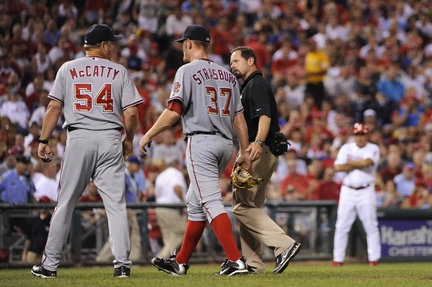 |
| Strasburg walks off the mound after his last ML appearance on August 21, 2010 |
Last June, Strasburg somehow matched the immense hype surrounding him by recording a Major League record 14 strikeouts in his first start, and proceeded to take the league by storm. In July, however, forearm pain forced him to the disabled list. He would return in August, but after three more starts he was shut down for the season. By the end of August it was apparent that right ulnar collateral ligament reconstruction--Tommy John surgery--would be necessary, and on September 3rd he had the procedure performed.
Just more than 11 months later, Strasburg took the mound for a rehab appearance with the Nationals' Low Single-A affiliate, Hagerstown. It was a lower level than he had ever pitched at before and he threw only 31 pitches over 1 2/3 innings before departing, but the excitement was palpable all the same. As he moved up through the minors, worked up higher pitch counts, and dominated opposing hitters in five of his six starts, it became more obvious that he would make it back to the Majors in 2011.
And, on Tuesday, September 4, that journey will be complete. Assuming he has no setbacks, he will make about five starts this year for Washington, something almost no one thought would be possible when he went under the knife twelve months ago. Lynn Zinser of the New York Times represented the prevailing opinion at the time, writing: "Strasburg... is facing a 12-to-18 month recovery from the operation and perhaps another season to recover his form." In defying the odds, Strasburg will give hope to other pitchers that they, too, can accomplish the same feat. Teams and fans will no longer hear Tommy John surgery as a death sentence that will keep the player out for 12 to 18 months, and even then have them return as a shell of their former self.
When Twins fans hear that their top prospect Kyle Gibson must have the same surgery, as was announced mere days ago, they can hold out hope that he will be able to pitch in a few games at the end of 2012. They don't have to look back on Joe Nathan and his 12-month recovery that saw him pitch poorly upon his return before finding himself back on the disabled list. Nor do they have to look at the horror story that followed Francisco Liriano's operation, which forced him out of game action for 18 months and then caused an absolutely miserable season when he did finally return.
Instead, they, and fans across baseball, can look at Strasburg's path, one that took only one year, almost exactly, before he was back at the Major League level and within reach of his former dominance. Beyond the fact that we as fans get to see him pitch again, Stephen Strasburg's return gives us hope for everyone else who receives the same diagnosis.
Article first published as Stephen Strasburg Returns to the Big Leagues on Technorati.
Friday, July 29, 2011
2010 Awards
Only about 8 months late, so nobody's interested. But I'm doing them for my own sake.
AL MVP: Josh Hamilton, Texas
AL Cy Young: Cliff Lee, Seattle/Texas
AL Relief Pitcher of the Year: Joaquin Benoit, Tampa Bay
AL Rookie of the Year: Austin Jackson, Detroit
NL MVP: Joey Votto, Cincinnati
NL Cy Young: Roy Halladay, Philadelphia
NL Relief Pitcher of the Year: Billy Wagner, Atlanta
NL Rookie of the Year: Jason Heyward, Atlanta
AL MVP: Josh Hamilton, Texas
AL Cy Young: Cliff Lee, Seattle/Texas
AL Relief Pitcher of the Year: Joaquin Benoit, Tampa Bay
AL Rookie of the Year: Austin Jackson, Detroit
NL MVP: Joey Votto, Cincinnati
NL Cy Young: Roy Halladay, Philadelphia
NL Relief Pitcher of the Year: Billy Wagner, Atlanta
NL Rookie of the Year: Jason Heyward, Atlanta
Monday, July 25, 2011
2010 All-MLB Teams
I've selected my First, Second, and Third All-MLB teams. Why Major League Baseball (and every major sports league) doesn't actually hand out these awards, I don't know. They do it in the NBA and it makes so much sense. It's a very simple and concise way to look back and determine the best players in a certain season; and looking at them over a period of time gives a very simple and concise summary of the best players of that era. Cy Young and MVP awards do that, but only for the best hitter and best pitcher in each league--the All-MLB teams cover a much wider swath. With the introduction out of the way, here are my selections.
ALL-MLB FIRST TEAM
Catcher: Joe Mauer, Minnesota
First Baseman: Joey Votto, Cincinnati
Second Baseman: Robinson Cano, New York AL
Third Baseman: Evan Longoria, Tampa Bay
Shortstop: Troy Tulowitzki, Colorado
Left Field: Josh Hamilton, Texas
Center Field: Andres Torres, San Francisco
Right Field: Joey Bautista, Toronto
Designated Hitter: David Ortiz, Boston
Starting Pitchers: Cliff Lee, Seattle/Texas; Roy Halladay, Philadelphia; Felix Hernandez, Seattle; Adam Wainwright, St. Louis; Jered Weaver, Los Angeles AL
Relief Pitchers: Joaquin Benoit, Tampa Bay; Billy Wagner, Atlanta; Hong-Chih Kuo, Los Angeles NL
ALL-MLB SECOND TEAM
Catcher: Brian McCann, Atlanta
First Baseman: Albert Pujols, St. Louis
Second Baseman: Kelly Johnson, Arizona
Third Baseman: Adrian Beltre, Boston
Shortstop: Hanley Ramirez, Florida
Left Field: Carlos Gonzalez, Colorado
Center Field: Chris Young, Arizona
Right Field: Shin-Soo Choo, Cleveland
Starting Pitchers: Josh Johnson, Florida; Francisco Liriano, Minnesota; Roy Oswalt, Houston/Philadelphia; Justin Verlander, Detroit; Ubaldo Jimenez, Colorado
Relief Pitchers: Joakim Soria, Kansas City; Carlos Marmol, Chicago NL; Matt Thornton, Chicago AL
ALL-MLB THIRD TEAM
Catcher: Victor Martinez, Boston
First Baseman: Miguel Cabrera, Detroit
Second Baseman: Rickie Weeks, Milwaukee
Third Baseman: Ryan Zimmerman, Washington
Shortstop: Stephen Drew, Arizona
Left Field: Carl Crawford, Tampa Bay
Center Field: Angel Pagan, New York NL
Right Field: Jayson Werth, Philadelphia
Starting Pitchers: Jon Lester, Boston; Mat Latos, San Diego; David Price, Tampa Bay; C.C. Sabathia, New York AL; Clayton Kershaw, Los Angeles NL
Relief Pitchers: Rafael Soriano, Tampa Bay; Mariano Rivera, New York AL; Brian Wilson, San Francisco
And that's that. A couple notes, though: 1) each player was available at only one position, the one they played most often; 2) a designated hitter was selected only for the first team because only 14 of 30 teams use one.
ALL-MLB FIRST TEAM
Catcher: Joe Mauer, Minnesota
First Baseman: Joey Votto, Cincinnati
Second Baseman: Robinson Cano, New York AL
Third Baseman: Evan Longoria, Tampa Bay
Shortstop: Troy Tulowitzki, Colorado
Left Field: Josh Hamilton, Texas
Center Field: Andres Torres, San Francisco
Right Field: Joey Bautista, Toronto
Designated Hitter: David Ortiz, Boston
Starting Pitchers: Cliff Lee, Seattle/Texas; Roy Halladay, Philadelphia; Felix Hernandez, Seattle; Adam Wainwright, St. Louis; Jered Weaver, Los Angeles AL
Relief Pitchers: Joaquin Benoit, Tampa Bay; Billy Wagner, Atlanta; Hong-Chih Kuo, Los Angeles NL
ALL-MLB SECOND TEAM
Catcher: Brian McCann, Atlanta
First Baseman: Albert Pujols, St. Louis
Second Baseman: Kelly Johnson, Arizona
Third Baseman: Adrian Beltre, Boston
Shortstop: Hanley Ramirez, Florida
Left Field: Carlos Gonzalez, Colorado
Center Field: Chris Young, Arizona
Right Field: Shin-Soo Choo, Cleveland
Starting Pitchers: Josh Johnson, Florida; Francisco Liriano, Minnesota; Roy Oswalt, Houston/Philadelphia; Justin Verlander, Detroit; Ubaldo Jimenez, Colorado
Relief Pitchers: Joakim Soria, Kansas City; Carlos Marmol, Chicago NL; Matt Thornton, Chicago AL
ALL-MLB THIRD TEAM
Catcher: Victor Martinez, Boston
First Baseman: Miguel Cabrera, Detroit
Second Baseman: Rickie Weeks, Milwaukee
Third Baseman: Ryan Zimmerman, Washington
Shortstop: Stephen Drew, Arizona
Left Field: Carl Crawford, Tampa Bay
Center Field: Angel Pagan, New York NL
Right Field: Jayson Werth, Philadelphia
Starting Pitchers: Jon Lester, Boston; Mat Latos, San Diego; David Price, Tampa Bay; C.C. Sabathia, New York AL; Clayton Kershaw, Los Angeles NL
Relief Pitchers: Rafael Soriano, Tampa Bay; Mariano Rivera, New York AL; Brian Wilson, San Francisco
And that's that. A couple notes, though: 1) each player was available at only one position, the one they played most often; 2) a designated hitter was selected only for the first team because only 14 of 30 teams use one.
Sunday, July 3, 2011
Fantasy Baseball: Pickups of the Week
With the season just passing the halfway point and the All Star break fast approaching, here are some widely available players who could help your team.
Rich Harden, SP, Oakland, 10% owned Yahoo, 7% ESPN
Everyone knows what this guy has done in the past when healthy. He struggled greatly last year with his control, but he finally made his 2011 debut on Friday against Arizona and walked none while striking out six. With a career average of over one strikeout per inning, Harden could be an asset in three categories, especially at home in pitcher-friendly Oakland, and can be acquired for nothing. He could struggle in WHIP if he can't keep the walks under control, but he's an easy start this week when he faces Seattle this week at home.
Cory Luebke, SP/RP, San Diego, 14%/15%
Luebke is another starting pitcher with strikeout potential in a favorable home work. Of course, an ineffective offense hurts his chances at wins, but I'd rather have a pitcher like Luebke helping me in three categories than a #4 starter with a high-powered offense who drags down my ratios. The one red flag with Luebke is that the return of Aarong Harang brings his rotation spot into question, but he has pitched very well in his two starts thus far and has an excellent matchup this week at San Francisco.
David Hernandez, RP, Arizona, 23%/18%
With JJ Putz hitting the disabled list with an elbow injury, David Hernandez has assumed the closer's role in Arizona. Hernandez already picked up his first save with a clean inning on Saturday. Hernandez is an obvious option for those looking to fill a short term need for saves, but with Putz's injury history and no firm timetable on his recovery, Hernandez could be worth speculating on for saves down the road too.
Joe Nathan, RP, Minnesota, 34%/32%
After Matt Capps turned a 7-4 lead into an 8-7 loss Saturday, Nathan moved one step closer to reclaiming the closer's role in Minnesota. Then on Sunday, Capps was pulled out of a save situation after giving up two more hits to the Brewers. Capps has always been a placeholder for Nathan until he's ready to resume closing, and with the way he and Capps have pitched since Nathan's return from the DL it probably won't be long now. Keep a close eye on this situation, and consider grabbing Nathan now if you're not usually the quickest to the wire.
Javy Guerra, RP, Los Angeles, 6%/10%
This is a pretty simple situation: Guerra is the Dodgers' closer right now. He may not be that good, the Dodgers may not be that good, and Guerra may not be the closer for the rest of the season, but right now he is the guy. In addition, Jonathan Broxton is now more than likely out for the year, which eliminates one of his main competitors.
Eric Thames, OF, Toronto, 4%/2%
If you hadn't checked the Toronto lineup for a week, you would notice a lot of differences. With Juan Rivera cut loose and Jose Bautista moved to third base, Thames, Corey Patterson, Rajai Davis, and the recalled Travis Snider will man the three outfield spots for the Blue Jays. Thames has been excellent in his second taste of the bigs, hitting three home runs in the past five games (including one each off of Roy Halladay and Cliff Lee). His playing time could come into question, although it's hard to imagine him sitting on the bench with the way he's played since his recall. He dominated AAA this year, albeit in the hitter-friendly PCL league, and offers the rarest of assets in 2011: power potential.
Rich Harden, SP, Oakland, 10% owned Yahoo, 7% ESPN
Everyone knows what this guy has done in the past when healthy. He struggled greatly last year with his control, but he finally made his 2011 debut on Friday against Arizona and walked none while striking out six. With a career average of over one strikeout per inning, Harden could be an asset in three categories, especially at home in pitcher-friendly Oakland, and can be acquired for nothing. He could struggle in WHIP if he can't keep the walks under control, but he's an easy start this week when he faces Seattle this week at home.
Cory Luebke, SP/RP, San Diego, 14%/15%
Luebke is another starting pitcher with strikeout potential in a favorable home work. Of course, an ineffective offense hurts his chances at wins, but I'd rather have a pitcher like Luebke helping me in three categories than a #4 starter with a high-powered offense who drags down my ratios. The one red flag with Luebke is that the return of Aarong Harang brings his rotation spot into question, but he has pitched very well in his two starts thus far and has an excellent matchup this week at San Francisco.
David Hernandez, RP, Arizona, 23%/18%
With JJ Putz hitting the disabled list with an elbow injury, David Hernandez has assumed the closer's role in Arizona. Hernandez already picked up his first save with a clean inning on Saturday. Hernandez is an obvious option for those looking to fill a short term need for saves, but with Putz's injury history and no firm timetable on his recovery, Hernandez could be worth speculating on for saves down the road too.
Joe Nathan, RP, Minnesota, 34%/32%
After Matt Capps turned a 7-4 lead into an 8-7 loss Saturday, Nathan moved one step closer to reclaiming the closer's role in Minnesota. Then on Sunday, Capps was pulled out of a save situation after giving up two more hits to the Brewers. Capps has always been a placeholder for Nathan until he's ready to resume closing, and with the way he and Capps have pitched since Nathan's return from the DL it probably won't be long now. Keep a close eye on this situation, and consider grabbing Nathan now if you're not usually the quickest to the wire.
Javy Guerra, RP, Los Angeles, 6%/10%
This is a pretty simple situation: Guerra is the Dodgers' closer right now. He may not be that good, the Dodgers may not be that good, and Guerra may not be the closer for the rest of the season, but right now he is the guy. In addition, Jonathan Broxton is now more than likely out for the year, which eliminates one of his main competitors.
Eric Thames, OF, Toronto, 4%/2%
If you hadn't checked the Toronto lineup for a week, you would notice a lot of differences. With Juan Rivera cut loose and Jose Bautista moved to third base, Thames, Corey Patterson, Rajai Davis, and the recalled Travis Snider will man the three outfield spots for the Blue Jays. Thames has been excellent in his second taste of the bigs, hitting three home runs in the past five games (including one each off of Roy Halladay and Cliff Lee). His playing time could come into question, although it's hard to imagine him sitting on the bench with the way he's played since his recall. He dominated AAA this year, albeit in the hitter-friendly PCL league, and offers the rarest of assets in 2011: power potential.
Monday, November 15, 2010
On the Unpredictability of Fantasy Baseball
Inevitably, when engrossed in a season of fantasy baseball, you'll receive a terrible offer or two that you'll quickly turn down, you'll offer trades that are promptly rejected, and you'll drop players who are never heard from again. But then there are times, of course, when you successfully work out a trade and it winds up as a great deal for you, or times when it completely backfires. And then, sometimes, another manager goes ahead and saves you from yourself.
Rewind to April 20, when Stephen Drew was hitting .314 with 2 homers, 7 RBIs, and a stolen base. Considering his very strong 2008 season, his age (27), and his very solid start, I figured Drew was a valuable commodity. And, with Ben Zobrist at shortstop, I also was ready to deal him. At that time, I was offered Paul Konerko straight up for Drew. To me, this was an obvious sell-high offer (and it probably was in the other manager's mind, too), as Konerko had slugged 5 home runs in his first 13 games. Konerko was on the wrong side of thirty and had averaged just 68 runs, 27 homers, and 80 RBIs to go along with a .260 average over the last three seasons. Given Drew's 2008 season, I thought there was a good chance Drew would outpace Konerko in raw totals even before you considered the positional adjustment.
So I rejected it. And you know how the story went from there. Konerko never slowed down, clocking 34 homers, driving in 101 RBIs, scoring 82 runs, and maintaining an average of .317 after April 20. In the meantime, Drew found himself floundering in the free agent pool after a poor stretch in the summer, and even after a late-season resurgence was never picked up. Does the other manager deserve credit for seeing Konerko's potential, or was he just lucky that I (and others) saved him from himself?
Fast forward to July 1, when I was in trade discussions with the same manager. I had a glut of outfielders and was trying to move one for a first basemen (too bad I didn't have Konerko, huh?). I proposed a swap of Carlos Gonzalez and Ryan Howard, since I also could afford to part with some stolen bases. At first glance, it seemed completely unfair, but a look at their 2010 numbers to that point showed them to be pretty similar: .299/47/12/46/11 for Gonzalez versus .295/52/15/55/0 for Howard. He rejected, citing Howard's track record against Gonzalez lack thereof, and countered with Gonzalez and Victor Martinez for Howard. That was an easy decision for me, as it was clearly too much, but I did respond with a proposal of those two for Howard and Lance Berkman.
And this time, it was he who saved me from myself. As you know, Gonzalez did not slow down; in fact, he hit even better after June 1 (.369/64/22/71/14) on his way to being the #1 rated player in Yahoo leagues. Victor Martinez, who was injured at the time, came back strong with a line of .316/28/11/41/0 to finish the season. On the other hand, Howard struggled through injury and relative ineffectiveness, hitting just .254 with 35 runs, 16 homers, and 53 RBIs the rest of the way. Berkman was even worse, however, as he accumulated just 22 runs, 7 homers, and 23 RBIs and hit only .246 over the final four months. Gonzalez vastly outperformed Howard in every category, while Martinez did the same to Berkman from the catcher position.
The point here is a larger one about the unpredictability of fantasy sports. As much as it is about knowledge and research, it's about luck. I don't think anyone would blame me for either of those offers for Howard (especially the one-for-one trade of Gonzalez), but either of those trades would have significantly hampered my team.
Rewind to April 20, when Stephen Drew was hitting .314 with 2 homers, 7 RBIs, and a stolen base. Considering his very strong 2008 season, his age (27), and his very solid start, I figured Drew was a valuable commodity. And, with Ben Zobrist at shortstop, I also was ready to deal him. At that time, I was offered Paul Konerko straight up for Drew. To me, this was an obvious sell-high offer (and it probably was in the other manager's mind, too), as Konerko had slugged 5 home runs in his first 13 games. Konerko was on the wrong side of thirty and had averaged just 68 runs, 27 homers, and 80 RBIs to go along with a .260 average over the last three seasons. Given Drew's 2008 season, I thought there was a good chance Drew would outpace Konerko in raw totals even before you considered the positional adjustment.
So I rejected it. And you know how the story went from there. Konerko never slowed down, clocking 34 homers, driving in 101 RBIs, scoring 82 runs, and maintaining an average of .317 after April 20. In the meantime, Drew found himself floundering in the free agent pool after a poor stretch in the summer, and even after a late-season resurgence was never picked up. Does the other manager deserve credit for seeing Konerko's potential, or was he just lucky that I (and others) saved him from himself?
Fast forward to July 1, when I was in trade discussions with the same manager. I had a glut of outfielders and was trying to move one for a first basemen (too bad I didn't have Konerko, huh?). I proposed a swap of Carlos Gonzalez and Ryan Howard, since I also could afford to part with some stolen bases. At first glance, it seemed completely unfair, but a look at their 2010 numbers to that point showed them to be pretty similar: .299/47/12/46/11 for Gonzalez versus .295/52/15/55/0 for Howard. He rejected, citing Howard's track record against Gonzalez lack thereof, and countered with Gonzalez and Victor Martinez for Howard. That was an easy decision for me, as it was clearly too much, but I did respond with a proposal of those two for Howard and Lance Berkman.
And this time, it was he who saved me from myself. As you know, Gonzalez did not slow down; in fact, he hit even better after June 1 (.369/64/22/71/14) on his way to being the #1 rated player in Yahoo leagues. Victor Martinez, who was injured at the time, came back strong with a line of .316/28/11/41/0 to finish the season. On the other hand, Howard struggled through injury and relative ineffectiveness, hitting just .254 with 35 runs, 16 homers, and 53 RBIs the rest of the way. Berkman was even worse, however, as he accumulated just 22 runs, 7 homers, and 23 RBIs and hit only .246 over the final four months. Gonzalez vastly outperformed Howard in every category, while Martinez did the same to Berkman from the catcher position.
The point here is a larger one about the unpredictability of fantasy sports. As much as it is about knowledge and research, it's about luck. I don't think anyone would blame me for either of those offers for Howard (especially the one-for-one trade of Gonzalez), but either of those trades would have significantly hampered my team.
Tuesday, July 13, 2010
My 2010 All-Star Rosters
These rosters were formulated with the ideas I discussed yesterday in mind. To summarize the main points:
-Each roster has 25 players.
-There are 9 starters, including a DH.
-There are 11 or 12 pitchers and 4 or 5 bench players.
-Players can re-enter the game any time in the event of an injury.
-Pitchers who start the Sunday before the All-Star Game are not replaced on the roster, but are not allowed to pitch unless the game goes into extra innings.
And a few new minor changes: the DH can switch to the field without forcing the pitcher to bat, and an actual centerfielder must be picked to play centerfield. Not someone like Carl Crawford who probably could play centerfield, but someone who actually plays centerfield. Right field and left field are interchangeable because they are about equal on the defensive spectrum.
And one more: there must be at least three relief pitchers and at least five starters. The last 3 or 4 pitchers could be either.
AMERICAN LEAGUE
Catcher: Victor Martinez (injured) - Boston, Joe Mauer - Minnesota, John Buck - Toronto (replacement)
Martinez is having another fine year, as he ranks 4th in HRs and 2nd in RBIs among AL catchers with at least 150 plate appearances, despite missing some time with an injury. He also is top-5 in average (2nd), on-base percent (4th), slugging percent (2nd), and OPS (2nd). Mauer is having a down year for him, but comes in right behind Martinez in terms of All-Star worthiness. I chose Buck as Martinez's replacement because he leads catchers in RBIs and slugging percent, and is 2nd in homers. It was tough to pick a guy with a 65-to-9 K:BB ratio, but the other options had problems with total playing time (Jorge Posada and John Jaso) or similar on-base issues (Kurt Suzuki and Mike Napoli).
First Base: Justin Morneau - Minnesota, Kevin Youkilis - Boston
It's a Twin and a Red Sock again. Don't fret, I haven't forgotten Miguel Cabrera, I just listed him as the DH. First base, as always, is a stacked position offensively. Morneau and Cabrera have been a step above the rest though, as Cabrera's counting numbers (namely home runs and RBIs) give him the edge whereas Morneau's defense is his advantage. That's also why Morneau was the obvious choice to play first base since the two were going to fill the 1B and DH spots, but I would have chosen Morneau even without the DH. Apologies to Paul Konerko and David Ortiz, who are having excellent seasons, but it's just not good enough at this position.
Second Base: Robinson Cano - New York, Dustin Pedroia (injured)
This was the easiest choice to make for the American League. He leads AL second basemen in runs, home runs, RBIs, batting average, slugging percent, OPS, wOBA, WAR... the list goes on and on. It helped that the obvious second choice, Dustin Pedroia, is injured, but that wouldn't have made it much closer anways.
Third Base: Evan Longoria - Tampa Bay, Adrian Beltre - Boston
Longoria, Adrian Beltre, and Jose Bautista form a very even group at the top offensively, as they have OPSs between .895 and .907 and wOBAs between .387 and .391. Longoria and Beltre distinguish themselves from Bautista with their defense, though (and by the fact that Bautista has played much more outfield than third base). It was pretty much a toss-up between those two, so I gave Longoria the edge because of his 13 stolen bases to Beltre's 1. Beltre still made it as a reserve, giving the Red Sox 4 players at the first 5 positions, before injuries struck. Alex Rodriguez's name is notably absent, and rightfully so; he'll be a hall of famer, but he's just not having as good a year as the 3 guys I already mentioned, or even a fourth I haven't, Michael Young.
Shortstop: Alex Gonzalez - Toronto
I actually had Derek Jeter filled in here before I even checked the shortstops, so don't accuse me of just not wanting to pick him. Actually, I wish I didn't have to pick a shortstop, since there haven't really been any standouts this year, but I do. And I really didn't want to pick a guy with a .296 OBP, but Gonzalez leads all other shorstops by 90 points in slugging, doubles the next one in home runs, leads them all in OPS by 60 points, and is first in wOBA and RBIs. Combined with some above average defense, he quickly convinced me that he was the choice in an underwhelming shortstop class.
Outfield: Carl Crawford, LF - Tampa Bay, Alex Rios, CF - Chicago, Josh Hamilton, RF - Texas, Torii Hunter - Los Angeles, Ben Zobrist - Tampa Bay (Pedroia's replacement)
Crawford is having a fantastic season in every facet of the game. His wOBA is .399, he's playing excellent defense, and he's second in the Majors in stolen bases. There was no way he would not make the team. Josh Hamilton leads AL outfielders in OPS and wOBA and has played around average defense to put himself in strong position for a starting job. He's played exclusively left field this year, but he did spend some time in right field last year so I moved him over there instead of Crawford. Rios, who somehow didn't make the real All-Star team, is easily the best centerfielder. His and Hunter's offensive stats are similar, but Rios has wreaked havoc on the basepaths and played a very good centerfield. Hunter still made the team as a reserve, as he is still managing average defense in centerfield to go with his very good offense in 2010. I really did not want to take Zobrist, but even in an exhibition game you need at least one backup middle infielder, and, with Pedroia's injury, Zobrist is more deserving than any of the actual middle infielders. He's played very good defense in the outfield (and in his limited time at second base) and has a healthy OBP of .386. Brennan Boesch, Jose Bautista, Nick Swisher, and Ichiro Suzuki were on the cusp (not necessarily in that order).
Designated Hitter: Miguel Cabrera - Detroit
Reasoning above, under the first base heading. David Ortiz and Vladimir Guerrero would be in tight race if this spot were reserved for an actual designated hitter.
As you can see, positional versatility played a role in only one choice (Zobrist). Instead of him I probably would have taken a twelfth pitcher. The next hitter would probably have been Tigers rookie Brennan Boesch. If I had wanted to take 12 pitchers and Zobrist, Adrian Beltre would have been cut from the roster. As for the lineup, it would look like this:
1. Carl Crawford - LF
2. Alex Rios - CF
3. Miguel Cabrera - DH
4. Justin Morneau - 1B
5. Josh Hamilton - RF
6. Robinson Cano - 2B
7. Evan Longoria - 3B
8. Joe Mauer - C
9. Alex Gonzalez - SS
Starting Pitcher: Cliff Lee - Seattle/Texas, Jon Lester - Boston, Felix Hernandez - Seattle, Jered Weaver - Los Angeles, Francisco Liriano - Minnesota, Zack Greinke - Kansas City, Colby Lewis - Texas
Unlike those who actually select the All-Star Game pitchers, I did not even look at the number of wins each player had. It's just a completely useless stat that has absolutely nothing to do with pitching ability. Unlike some sabermetrically-inclined fans, however, I do consider ERA and WHIP. I also look at FIP and xFIP, so my decision is sort of a blend of the two. Lee is the starter but the rest are in no particular order. Lewis was a tough decision over the likes of David Price, Justin Verlander, C.C. Sabathia, Ricky Romero, and Phil Hughes (in that order). Lewis certainly surprised me as I had no idea he would be deserving before I went to look at the statistics.
Relief Pitcher: Joaquin Benoit - Tampa Bay, Mariano Rivera - New York, J.J. Putz - Chicago, Darren Oliver - Texas
Before I looked at the relievers, I had Price penciled in as an eighth starter. There were just too many good relievers to limit it to 3, though. As you can see, I only chose one closer (Rivera). I did value saves, but these guys were just too much better. Not that there weren't any good closers; I could have easily chosen Jose Valverde, Rafael Soriano, or Andrew Bailey. Valverde's K:BB rate wasn't quite good enough, Soriano strikeouts were a tad low, and Bailey's WHIP was a little high. Obviously I'm nit-picking, because these guys are all having great years, but just not quite good enough. Benoit's stats were just ridiculous, despite limited innings: 40 strikeouts against 4 walks and 10 hits in 27.2 innings, resulting in a 0.51 WHIP, 0.65 ERA, and 1.60 FIP. Rivera is having his typical utterly dominant season, while Putz is just a notch under Benoit's ratios in 34 innings with Oliver another small step below in 39.2 innings. Daniel Bard and Matt Thornton were the other non-closers I considered.
NATIONAL LEAGUE
Catcher: Miguel Olivo - Colorado, Geovany Soto - Chicago
Olivo was an easy choice, as he's been having a wonderful season. He leads NL catchers in average, homers, RBIs, slugging percent, OPS, and wOBA. His defense also rates very highly, but I take that with a grain of salt because I really don't trust ratings of catcher defense. The backup spot was a tight race between Soto and Brian McCann, but McCann really only has an argument if you value playing time and trust measurements of catcher defense. Offensively, Soto has surely outperformed McCann, and the small difference in the unreliable statistic of catcher defense doesn't pick up the slack for me.
First Base: Joey Votto - Cincinnati, Adrian Gonzalez - San Diego
Wow. Absolutely stacked, as is the usual at first base. Six guys have a wOBA over .390 (and none of them is Ryan Howard). Votto leads the pack with an OPS over 1.000 and a wOBA at .433. Him and Albert Pujols (don't worry, he's listed as the DH) also steal a few bases, which add a small bit to their value. Adrian Gonzalez barely nabs the third first base spot over Adam Dunn thanks to his superior defense. Not that there are specifically three spots available, I just can't justify four first basemen on a 25-man roster. Apologies to Aubrey Huff and Prince Fielder who are also deserving of an all-star spot.
Second Base: Chase Utley - Philadelphia (injured), Kelly Johnson - Arizona, Martin Prado - Atlanta (replacement)
Second base in the National League doesn't have a front-runner like Cano in the AL, but it has plenty of guys around the same level. Utley, Johnson, Martin Prado, Dan Uggla, Brandon Phillips, and Rickie Weeks are all tightly packed. Utley gets the nod not because of his reputation, but because a down year offensively for him, as is the case in 2010, is as good as the other options and his superb defense lifts him above the rest. Since he's injured, I had to pick someone to replace him; after much debate I settled on Johnson because he has the best offensive stats. His value is a little lower than the rest, in terms of WAR, but that's only due to his fewer plate appearances than Prado and Phillips. This one is pretty much a toss-up so though.
Third Base: David Wright - New York, Ryan Zimmerman - Washington
Wright and Zimmerman are clearly the class of the NL third base class. Both hit for average and both hit for power, while Wright steals bases and Zimmerman strikes out much less often. They also both play at least good defense, with Zimmerman's rating as excellent. Wright got the starting nod, but it was pretty much a coin toss, and both definitely deserved to make the team. Scott Rolen was the only guy close to them, and even he was a ways off.
Shortstop: Hanley Ramirez - Florida
This was, without a doubt, the easiest choice of this whole process. In an incredibly weak shortstop pool across the Majors, Ramirez stands out even more. While Stephen Drew actually rates relatively close in terms of WAR, it's based solely on his far superior defensive rating. Of course that has worth, but when Ramirez rates leagues ahead of the rest of the field in the much more reliable offensive statistical categories, it's no competition. He ranks first in home runs, RBIs, average, slugging percent, on-base percent, OPS (by over 100 points), and wOBA (by 37 points). He also is second in runs and stolen bases.
Outfield: Matt Holliday, LF - St. Louis, Andres Torres, CF - San Francisco, Josh Willingham, RF - Washington, Angel Pagan, OF - New York
The names here are very different from the actual NL All-Star outfielders. Going in, I thought guys like Justin Upton and Andrew McCutchen would prove deserving, but they, along with guys like Matt Kemp, Colby Rasmus, Jason Heyward, Ryan Braun, Carlos Gonzalez, Jayson Werth, Corey Hart, and Chris Young were outshone by lesser names. Torres and Pagan beat out the big names with the big power numbers through solid on-base percentages, lots of stolen bases, and well above average defense. Willingham did it by posting the highest wOBA of any NL outfielder (.404) and playing average defense. Holliday is a big name, and marked his spot with a 4th-place wOBA (.390) and some great defense at a corner spot. Andre Ethier's horrible defense and missed time prevented him from getting a roster spot; one or the other could have been overlooked, but not both. Aubrey Huff just missed out at this position, too, in addition to first base.
Designated Hitter: Albert Pujols - St. Louis
Description above, under the first base heading.
Again, Prado was only chosen because of the need for a backup middle infielder. Johnson would have been chosen for that reason had Utley not been injured. If I didn't feel the need for one, Huff would have been added. If there was a 12th pitcher, I'd reluctantly have to take off the very deserving Ryan Zimmerman, since none of the other guys can play the outfield and the team needs an outfield sub. The lineup:
1. Andres Torres - CF
2. Hanley Ramirez - SS
3. Joey Votto - 1B
4. Albert Pujols - DH
5. Matt Holliday - LF
6. Josh Willingham - RF
7. David Wright - 3B
8. Kelly Johnson - 2B
9. Miguel Olivo - C
Starting Pitcher: Josh Johnson - Florida, Roy Halladay - Philadelphia, Adam Wainwright - St. Louis, Ubaldo Jimenez - Colorado, Mat Latos - San Diego, Yovani Gallardo - Milwaukee (injured), Roy Oswalt - Houston, Clayton Kershaw - Los Angeles (replacement)
This was a very tough decision, as there were many deserving candidates. Tim Lincecum just missed the cut, as it came down to him and Kershaw to replace Gallardo on the roster. In the end, Kershaw's slightly lower WHIP convinced me to add him. Johnson is the starter, but again, the rest is in no particular order. Halladay made it thanks to all-around great pitching, Wainwright and Latos thanks to their sub-1.00 WHIPs and K:BB ratios over 3.50. Jimenez and Oswalt were a step below those guys, Jimenez because of his K:BB ratio and Oswalt because of his ERA. Kershaw got the last spot on the strength of his huge strikeout rate.
Relief Pitcher: Billy Wagner - Atlanta, Jonathan Broxton - Los Angeles, Hong-Chih Kuo - Los Angeles, Matt Belisle - Colorado
I am a total sucker for big strikeout rates, so Carlos Marmol was very close to making it, but the other guys just had a little too much. I really, really wanted to take him, but his WHIP was just too high compared to these other guys. Wagner and Broxton almost made up for Marmol missing the cut with their own killer strikeout rates, but not quite. Wagner's WHIP of 0.86 buoyed his resume, while Broxton's ridiculous 1.21 FIP and 7.86 K:BB ratio made him a no-brainer. Kuo joined his Dodger teammate on the strength of a 0.99 ERA and 1.83 FIP. Belisle's numbers, while excellent, weren't quite as good as the other choices--or some of the guys who just missed the team--but I credited him for his workload (54 innings). A trio of Padres, Mike Adams, Luke Gregerson, and Heath Bell, were among those considered, a group that also included Evan Meek and Sean Marshall.
Wow, did this take a long time. I'm happy with how the rosters turned out, although the NL outfield in particular was a shock to me. I did not want to pick the guys I did--I wanted to pick the players with the big power numbers and the good traditional stats--but no matter how I looked at it they just didn't warrant a selection. The decisions were tough, and some deserving players were left off, but that's the way an All-Star Game is supposed to be. That way the players who are selected realize that it is in fact an honor, and not something that every Omar Infante out there can attend.
-Each roster has 25 players.
-There are 9 starters, including a DH.
-There are 11 or 12 pitchers and 4 or 5 bench players.
-Players can re-enter the game any time in the event of an injury.
-Pitchers who start the Sunday before the All-Star Game are not replaced on the roster, but are not allowed to pitch unless the game goes into extra innings.
And a few new minor changes: the DH can switch to the field without forcing the pitcher to bat, and an actual centerfielder must be picked to play centerfield. Not someone like Carl Crawford who probably could play centerfield, but someone who actually plays centerfield. Right field and left field are interchangeable because they are about equal on the defensive spectrum.
And one more: there must be at least three relief pitchers and at least five starters. The last 3 or 4 pitchers could be either.
AMERICAN LEAGUE
Catcher: Victor Martinez (injured) - Boston, Joe Mauer - Minnesota, John Buck - Toronto (replacement)
Martinez is having another fine year, as he ranks 4th in HRs and 2nd in RBIs among AL catchers with at least 150 plate appearances, despite missing some time with an injury. He also is top-5 in average (2nd), on-base percent (4th), slugging percent (2nd), and OPS (2nd). Mauer is having a down year for him, but comes in right behind Martinez in terms of All-Star worthiness. I chose Buck as Martinez's replacement because he leads catchers in RBIs and slugging percent, and is 2nd in homers. It was tough to pick a guy with a 65-to-9 K:BB ratio, but the other options had problems with total playing time (Jorge Posada and John Jaso) or similar on-base issues (Kurt Suzuki and Mike Napoli).
First Base: Justin Morneau - Minnesota, Kevin Youkilis - Boston
It's a Twin and a Red Sock again. Don't fret, I haven't forgotten Miguel Cabrera, I just listed him as the DH. First base, as always, is a stacked position offensively. Morneau and Cabrera have been a step above the rest though, as Cabrera's counting numbers (namely home runs and RBIs) give him the edge whereas Morneau's defense is his advantage. That's also why Morneau was the obvious choice to play first base since the two were going to fill the 1B and DH spots, but I would have chosen Morneau even without the DH. Apologies to Paul Konerko and David Ortiz, who are having excellent seasons, but it's just not good enough at this position.
Second Base: Robinson Cano - New York, Dustin Pedroia (injured)
This was the easiest choice to make for the American League. He leads AL second basemen in runs, home runs, RBIs, batting average, slugging percent, OPS, wOBA, WAR... the list goes on and on. It helped that the obvious second choice, Dustin Pedroia, is injured, but that wouldn't have made it much closer anways.
Third Base: Evan Longoria - Tampa Bay, Adrian Beltre - Boston
Longoria, Adrian Beltre, and Jose Bautista form a very even group at the top offensively, as they have OPSs between .895 and .907 and wOBAs between .387 and .391. Longoria and Beltre distinguish themselves from Bautista with their defense, though (and by the fact that Bautista has played much more outfield than third base). It was pretty much a toss-up between those two, so I gave Longoria the edge because of his 13 stolen bases to Beltre's 1. Beltre still made it as a reserve, giving the Red Sox 4 players at the first 5 positions, before injuries struck. Alex Rodriguez's name is notably absent, and rightfully so; he'll be a hall of famer, but he's just not having as good a year as the 3 guys I already mentioned, or even a fourth I haven't, Michael Young.
Shortstop: Alex Gonzalez - Toronto
I actually had Derek Jeter filled in here before I even checked the shortstops, so don't accuse me of just not wanting to pick him. Actually, I wish I didn't have to pick a shortstop, since there haven't really been any standouts this year, but I do. And I really didn't want to pick a guy with a .296 OBP, but Gonzalez leads all other shorstops by 90 points in slugging, doubles the next one in home runs, leads them all in OPS by 60 points, and is first in wOBA and RBIs. Combined with some above average defense, he quickly convinced me that he was the choice in an underwhelming shortstop class.
Outfield: Carl Crawford, LF - Tampa Bay, Alex Rios, CF - Chicago, Josh Hamilton, RF - Texas, Torii Hunter - Los Angeles, Ben Zobrist - Tampa Bay (Pedroia's replacement)
Crawford is having a fantastic season in every facet of the game. His wOBA is .399, he's playing excellent defense, and he's second in the Majors in stolen bases. There was no way he would not make the team. Josh Hamilton leads AL outfielders in OPS and wOBA and has played around average defense to put himself in strong position for a starting job. He's played exclusively left field this year, but he did spend some time in right field last year so I moved him over there instead of Crawford. Rios, who somehow didn't make the real All-Star team, is easily the best centerfielder. His and Hunter's offensive stats are similar, but Rios has wreaked havoc on the basepaths and played a very good centerfield. Hunter still made the team as a reserve, as he is still managing average defense in centerfield to go with his very good offense in 2010. I really did not want to take Zobrist, but even in an exhibition game you need at least one backup middle infielder, and, with Pedroia's injury, Zobrist is more deserving than any of the actual middle infielders. He's played very good defense in the outfield (and in his limited time at second base) and has a healthy OBP of .386. Brennan Boesch, Jose Bautista, Nick Swisher, and Ichiro Suzuki were on the cusp (not necessarily in that order).
Designated Hitter: Miguel Cabrera - Detroit
Reasoning above, under the first base heading. David Ortiz and Vladimir Guerrero would be in tight race if this spot were reserved for an actual designated hitter.
As you can see, positional versatility played a role in only one choice (Zobrist). Instead of him I probably would have taken a twelfth pitcher. The next hitter would probably have been Tigers rookie Brennan Boesch. If I had wanted to take 12 pitchers and Zobrist, Adrian Beltre would have been cut from the roster. As for the lineup, it would look like this:
1. Carl Crawford - LF
2. Alex Rios - CF
3. Miguel Cabrera - DH
4. Justin Morneau - 1B
5. Josh Hamilton - RF
6. Robinson Cano - 2B
7. Evan Longoria - 3B
8. Joe Mauer - C
9. Alex Gonzalez - SS
Starting Pitcher: Cliff Lee - Seattle/Texas, Jon Lester - Boston, Felix Hernandez - Seattle, Jered Weaver - Los Angeles, Francisco Liriano - Minnesota, Zack Greinke - Kansas City, Colby Lewis - Texas
Unlike those who actually select the All-Star Game pitchers, I did not even look at the number of wins each player had. It's just a completely useless stat that has absolutely nothing to do with pitching ability. Unlike some sabermetrically-inclined fans, however, I do consider ERA and WHIP. I also look at FIP and xFIP, so my decision is sort of a blend of the two. Lee is the starter but the rest are in no particular order. Lewis was a tough decision over the likes of David Price, Justin Verlander, C.C. Sabathia, Ricky Romero, and Phil Hughes (in that order). Lewis certainly surprised me as I had no idea he would be deserving before I went to look at the statistics.
Relief Pitcher: Joaquin Benoit - Tampa Bay, Mariano Rivera - New York, J.J. Putz - Chicago, Darren Oliver - Texas
Before I looked at the relievers, I had Price penciled in as an eighth starter. There were just too many good relievers to limit it to 3, though. As you can see, I only chose one closer (Rivera). I did value saves, but these guys were just too much better. Not that there weren't any good closers; I could have easily chosen Jose Valverde, Rafael Soriano, or Andrew Bailey. Valverde's K:BB rate wasn't quite good enough, Soriano strikeouts were a tad low, and Bailey's WHIP was a little high. Obviously I'm nit-picking, because these guys are all having great years, but just not quite good enough. Benoit's stats were just ridiculous, despite limited innings: 40 strikeouts against 4 walks and 10 hits in 27.2 innings, resulting in a 0.51 WHIP, 0.65 ERA, and 1.60 FIP. Rivera is having his typical utterly dominant season, while Putz is just a notch under Benoit's ratios in 34 innings with Oliver another small step below in 39.2 innings. Daniel Bard and Matt Thornton were the other non-closers I considered.
NATIONAL LEAGUE
Catcher: Miguel Olivo - Colorado, Geovany Soto - Chicago
Olivo was an easy choice, as he's been having a wonderful season. He leads NL catchers in average, homers, RBIs, slugging percent, OPS, and wOBA. His defense also rates very highly, but I take that with a grain of salt because I really don't trust ratings of catcher defense. The backup spot was a tight race between Soto and Brian McCann, but McCann really only has an argument if you value playing time and trust measurements of catcher defense. Offensively, Soto has surely outperformed McCann, and the small difference in the unreliable statistic of catcher defense doesn't pick up the slack for me.
First Base: Joey Votto - Cincinnati, Adrian Gonzalez - San Diego
Wow. Absolutely stacked, as is the usual at first base. Six guys have a wOBA over .390 (and none of them is Ryan Howard). Votto leads the pack with an OPS over 1.000 and a wOBA at .433. Him and Albert Pujols (don't worry, he's listed as the DH) also steal a few bases, which add a small bit to their value. Adrian Gonzalez barely nabs the third first base spot over Adam Dunn thanks to his superior defense. Not that there are specifically three spots available, I just can't justify four first basemen on a 25-man roster. Apologies to Aubrey Huff and Prince Fielder who are also deserving of an all-star spot.
Second Base: Chase Utley - Philadelphia (injured), Kelly Johnson - Arizona, Martin Prado - Atlanta (replacement)
Second base in the National League doesn't have a front-runner like Cano in the AL, but it has plenty of guys around the same level. Utley, Johnson, Martin Prado, Dan Uggla, Brandon Phillips, and Rickie Weeks are all tightly packed. Utley gets the nod not because of his reputation, but because a down year offensively for him, as is the case in 2010, is as good as the other options and his superb defense lifts him above the rest. Since he's injured, I had to pick someone to replace him; after much debate I settled on Johnson because he has the best offensive stats. His value is a little lower than the rest, in terms of WAR, but that's only due to his fewer plate appearances than Prado and Phillips. This one is pretty much a toss-up so though.
Third Base: David Wright - New York, Ryan Zimmerman - Washington
Wright and Zimmerman are clearly the class of the NL third base class. Both hit for average and both hit for power, while Wright steals bases and Zimmerman strikes out much less often. They also both play at least good defense, with Zimmerman's rating as excellent. Wright got the starting nod, but it was pretty much a coin toss, and both definitely deserved to make the team. Scott Rolen was the only guy close to them, and even he was a ways off.
Shortstop: Hanley Ramirez - Florida
This was, without a doubt, the easiest choice of this whole process. In an incredibly weak shortstop pool across the Majors, Ramirez stands out even more. While Stephen Drew actually rates relatively close in terms of WAR, it's based solely on his far superior defensive rating. Of course that has worth, but when Ramirez rates leagues ahead of the rest of the field in the much more reliable offensive statistical categories, it's no competition. He ranks first in home runs, RBIs, average, slugging percent, on-base percent, OPS (by over 100 points), and wOBA (by 37 points). He also is second in runs and stolen bases.
Outfield: Matt Holliday, LF - St. Louis, Andres Torres, CF - San Francisco, Josh Willingham, RF - Washington, Angel Pagan, OF - New York
The names here are very different from the actual NL All-Star outfielders. Going in, I thought guys like Justin Upton and Andrew McCutchen would prove deserving, but they, along with guys like Matt Kemp, Colby Rasmus, Jason Heyward, Ryan Braun, Carlos Gonzalez, Jayson Werth, Corey Hart, and Chris Young were outshone by lesser names. Torres and Pagan beat out the big names with the big power numbers through solid on-base percentages, lots of stolen bases, and well above average defense. Willingham did it by posting the highest wOBA of any NL outfielder (.404) and playing average defense. Holliday is a big name, and marked his spot with a 4th-place wOBA (.390) and some great defense at a corner spot. Andre Ethier's horrible defense and missed time prevented him from getting a roster spot; one or the other could have been overlooked, but not both. Aubrey Huff just missed out at this position, too, in addition to first base.
Designated Hitter: Albert Pujols - St. Louis
Description above, under the first base heading.
Again, Prado was only chosen because of the need for a backup middle infielder. Johnson would have been chosen for that reason had Utley not been injured. If I didn't feel the need for one, Huff would have been added. If there was a 12th pitcher, I'd reluctantly have to take off the very deserving Ryan Zimmerman, since none of the other guys can play the outfield and the team needs an outfield sub. The lineup:
1. Andres Torres - CF
2. Hanley Ramirez - SS
3. Joey Votto - 1B
4. Albert Pujols - DH
5. Matt Holliday - LF
6. Josh Willingham - RF
7. David Wright - 3B
8. Kelly Johnson - 2B
9. Miguel Olivo - C
Starting Pitcher: Josh Johnson - Florida, Roy Halladay - Philadelphia, Adam Wainwright - St. Louis, Ubaldo Jimenez - Colorado, Mat Latos - San Diego, Yovani Gallardo - Milwaukee (injured), Roy Oswalt - Houston, Clayton Kershaw - Los Angeles (replacement)
This was a very tough decision, as there were many deserving candidates. Tim Lincecum just missed the cut, as it came down to him and Kershaw to replace Gallardo on the roster. In the end, Kershaw's slightly lower WHIP convinced me to add him. Johnson is the starter, but again, the rest is in no particular order. Halladay made it thanks to all-around great pitching, Wainwright and Latos thanks to their sub-1.00 WHIPs and K:BB ratios over 3.50. Jimenez and Oswalt were a step below those guys, Jimenez because of his K:BB ratio and Oswalt because of his ERA. Kershaw got the last spot on the strength of his huge strikeout rate.
Relief Pitcher: Billy Wagner - Atlanta, Jonathan Broxton - Los Angeles, Hong-Chih Kuo - Los Angeles, Matt Belisle - Colorado
I am a total sucker for big strikeout rates, so Carlos Marmol was very close to making it, but the other guys just had a little too much. I really, really wanted to take him, but his WHIP was just too high compared to these other guys. Wagner and Broxton almost made up for Marmol missing the cut with their own killer strikeout rates, but not quite. Wagner's WHIP of 0.86 buoyed his resume, while Broxton's ridiculous 1.21 FIP and 7.86 K:BB ratio made him a no-brainer. Kuo joined his Dodger teammate on the strength of a 0.99 ERA and 1.83 FIP. Belisle's numbers, while excellent, weren't quite as good as the other choices--or some of the guys who just missed the team--but I credited him for his workload (54 innings). A trio of Padres, Mike Adams, Luke Gregerson, and Heath Bell, were among those considered, a group that also included Evan Meek and Sean Marshall.
Wow, did this take a long time. I'm happy with how the rosters turned out, although the NL outfield in particular was a shock to me. I did not want to pick the guys I did--I wanted to pick the players with the big power numbers and the good traditional stats--but no matter how I looked at it they just didn't warrant a selection. The decisions were tough, and some deserving players were left off, but that's the way an All-Star Game is supposed to be. That way the players who are selected realize that it is in fact an honor, and not something that every Omar Infante out there can attend.
Subscribe to:
Posts (Atom)


 Posts
Posts


